
British India Images
The Passage to India
The British dominions in India took shape gradually. In the very early years of the 17th century British merchants of the East India Company set out to trade with the fabulous Mughal empire. As that empire declined, the British took political and military control of Indian territory, defeating the French and various Indian rulers to become the dominant power. Britain ruled India through the East India Company until after the terrible rebellion of 1857-58, when India came to be ruled directly by the British crown.As the British presence in India grew, Britons increasingly went to India to run businesses and as administrators, soldiers, and missionaries. By the 19th century and into the 20th a life in India became a regular existence for many English men and women. Their personal motives were various: to make money, to find excitement, to improve their status, to maintain family tradition, and -- as a grand ideal of imperial service formed in Victorian times -- to serve their own nation and India itself. In many ways their personal motives are a microcosm of the reasons European nations and their societies sought imperial expansion.
Sometimes generations of the same family went to India. Some were born there, others recruited out of university or public school to join the police or the civil or the education or forest service. Whatever their backgrounds, those who went found themselves on a journey to a world very different from what they knew in the British Isles. Their literal passage on a steamship -- from cool England, through Gibraltar and across the increasingly foreign Mediterranean, through the Suez Canal (symbolic divider of West from East), into the sun-scorched Red Sea and steamy Indian Ocean to a land full of new sounds, sights, and smells -- was more than a mere trip but a rite of transition which often made a powerful impression.
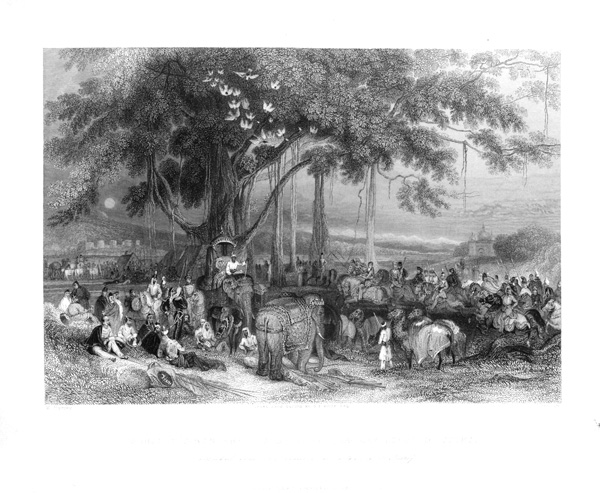 "Runjeet Singh and His Suwarree, or Cavalcade of Seiks"; steel
engraving after a drawing by G.F. White; 1837.
"Runjeet Singh and His Suwarree, or Cavalcade of Seiks"; steel
engraving after a drawing by G.F. White; 1837.
Maharaja Ranjit Singh, who ruled his co-religionist Sikhs in a kingdom that centered on the Punjab, was the last powerful independent ruler on the Indian subcontinent, others having been defeated, their lands annexed by the expanding British dominion. After his death in 1839, the Sikh kingdom also crumbled to British power.
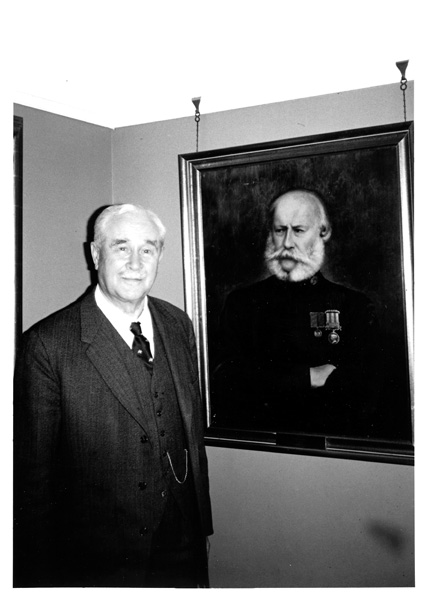 Family tradition: Colonel W.A. Salmon,
who served in India in the 1930s with the Highland Light Infantry
and as aide to the Governor of Sind, poses with a portrait of an ancestor
who was in East India Company Service; photograph by
Rosan Augusta Jordan; 1979.
Family tradition: Colonel W.A. Salmon,
who served in India in the 1930s with the Highland Light Infantry
and as aide to the Governor of Sind, poses with a portrait of an ancestor
who was in East India Company Service; photograph by
Rosan Augusta Jordan; 1979.
 The P. and O. Pocket Book, 2nd edition (London: Peninsular and
Oriental Steam Navigation Co., 1899).
The P. and O. was widely considered the premier shipping line for
transportation to India ("a junior branch of the Royal Navy,"
according to some). The little guidebook provided for passengers
(first published in 1888) included information on ports of call,
essays on countries served, advice for travellers, maps, and
meteorological tables.
The P. and O. Pocket Book, 2nd edition (London: Peninsular and
Oriental Steam Navigation Co., 1899).
The P. and O. was widely considered the premier shipping line for
transportation to India ("a junior branch of the Royal Navy,"
according to some). The little guidebook provided for passengers
(first published in 1888) included information on ports of call,
essays on countries served, advice for travellers, maps, and
meteorological tables.
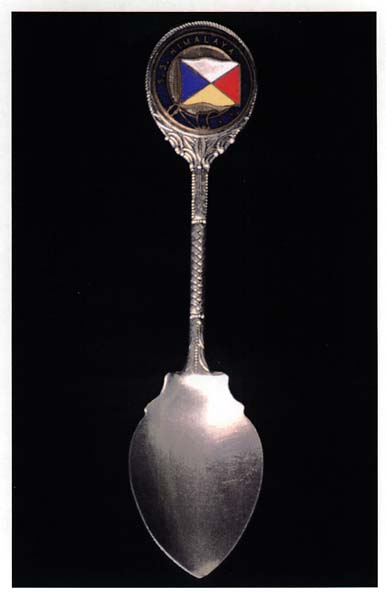 Souvenir spoon from the P. and O. liner "Himalaya"; 1950s.


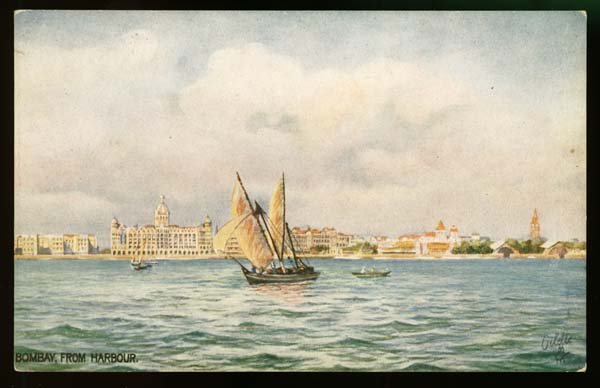

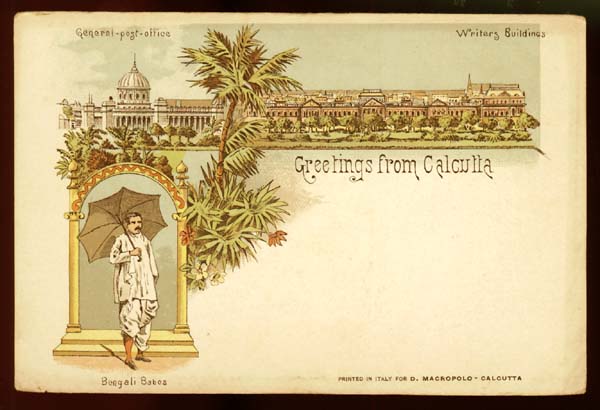
Postcards (late 19th century-1920s) trace the voyage through Suez to Indian destinations. Cards depicting vessels were produced by Raphael Tuck and Sons and provided to travelers by steamship companies, in this case the P. and O. and the Orient Lines. "Bombay, from Harbour" is from a Tuck "Bombay" series.
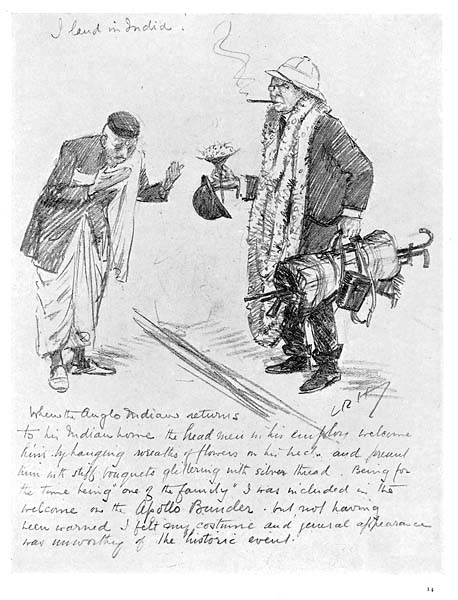
Finally, "I land in India," in Raven-Hill's Indian Sketch Book by L. Raven-Hill (London: "Punch" Office, 1903). Englishmen arriving in India were a popular subject for illustrations, often humorous ones. Such illustrations commonly depict his confusion or discomfort upon first encountering the "natives" and are indicative of the feeling of entering a very different world that many British encountered upon going to India.
Running Your Little Empire
Those who went to India remembered it as a place of hard work and recalled sometimes resenting British popular stereotypes of them as having lives of leisure--waited on by servants, spending time in posh clubs, attending balls, riding to hounds. They saw the work of empire as demanding, difficult, and at times dangerous. Numerically "thin on the ground," they often assumed great responsibilities and administered vast territories or supervised numerous underlings.The Indian Civil Service (or ICS) provided the men who governed India. Graduates of British universities who had passed an examination and interviews and then undertaken a year of training in England, most eventually worked as district officers, virtual rulers of the several hundred districts which were basic administrative units. Assisted by perhaps a few other Europeans as well as Indian officials and clerks, they might render legal decisions, determine land tenure, oversee local police, recommend public works projects, provide famine relief when necessary, even hunt leopards or tigers which menaced villagers. Their power and prestige were such that they were jokingly called "the heaven born" and likened to the Brahmans who stood at the top of the Indian caste system.
Other men assumed administrative positions in such organizations as the Forest Service, which cared for great jungle preserves; the Education Service, which ran schools; the Survey of India, which mapped the subcontinent; the state-owned railways; the Police; and the Political Service (made up of already-experienced officers from the ICS or the Army), which dealt with the Indian princes who ruled large portions of India under British oversight (they also staffed British consulates in parts of China and Persia and helped administer the sheikdoms of the Persian Gulf). Others joined commercial enterprises, such as the great trading houses of Calcutta and tea, coffee or jute plantations.
The military life also took many to India. India, in fact, had two large armies. The British Army posted a big part of its strength to India. But there was also the largely separate Indian Army, with British officers and Indian soldiers. Stationed in far-flung cantonments, Army officers worked in support of the civil administrators in maintaining control and engaged in the intermittent warfare which broke out in such areas as the Northwest Frontier, where potentially rebellious tribesmen kept the region unsettled.
Official India was virtually all male, but wives would often play major roles in their husbands' work, touring with them, ministering to local needs, and discovering local problems. Women might also lead more independent lives in mission work or in healing professions.
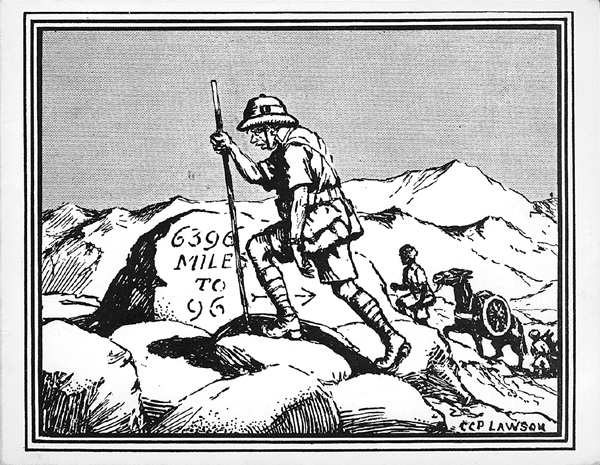 Christmas card produced for members of the Junior Naval and Military
Club; 1930s. "96" refers to club's London address; the card refers to
distant imperial postings of many members, such as this "gunner"
(Royal Artillery officer) depicted with his Indian mountain battery
on the Northwest Frontier.
Christmas card produced for members of the Junior Naval and Military
Club; 1930s. "96" refers to club's London address; the card refers to
distant imperial postings of many members, such as this "gunner"
(Royal Artillery officer) depicted with his Indian mountain battery
on the Northwest Frontier.
Wife of an ICS officer on tour in Surat; photograph courtesy of the Centre of South Asian Studies
 , University of Cambridge; 1929.
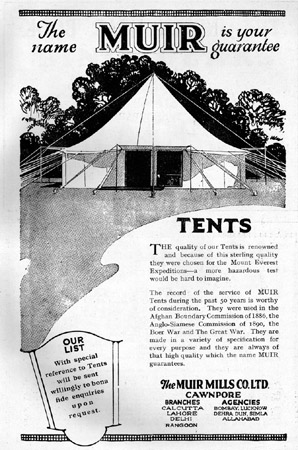 Advertisement for tents in the Hoghunter's Annual (Calcutta) for
1930.
Advertisement for tents in the Hoghunter's Annual (Calcutta) for
1930. Tents were an essential ingredient of English life in India. Officials, particularly district officers, commonly spent a significant part of the year "on tour," traveling around the areas of which they were in charge, listening to residents, dispensing decisions, and inspecting conditions. The tents were often commodious and a touring official might have virtually a multi-room canvas house; they were taken down by servants in the morning and sent ahead to the next camp site and set up, ready for the officer's arrival; such conveniences as portable metal bath tubs would be carried along.
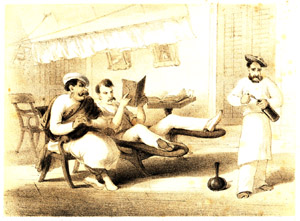 "Our
Moonshee," lithograph in Curry and Rice on Forty Plates by
George Francklin Atkinson; 3rd edition (London: Day and Son, 1859?).
"Our
Moonshee," lithograph in Curry and Rice on Forty Plates by
George Francklin Atkinson; 3rd edition (London: Day and Son, 1859?).
Because they needed to conduct business in Indian languages, British soldiers and administrators labored to acquire local vernaculars, through the aid of a munshi or language instructor. Atkinson's lithographs depict with dry humor life in a "typical" English "station" in the second half of the 19th century.
 "A
Doctor's Travelling Tent"; color postcard ( London: All-British
Picture Co., Ltd.; no. 9 in the "Indian Medical" series); 20th century.
"A
Doctor's Travelling Tent"; color postcard ( London: All-British
Picture Co., Ltd.; no. 9 in the "Indian Medical" series); 20th century.
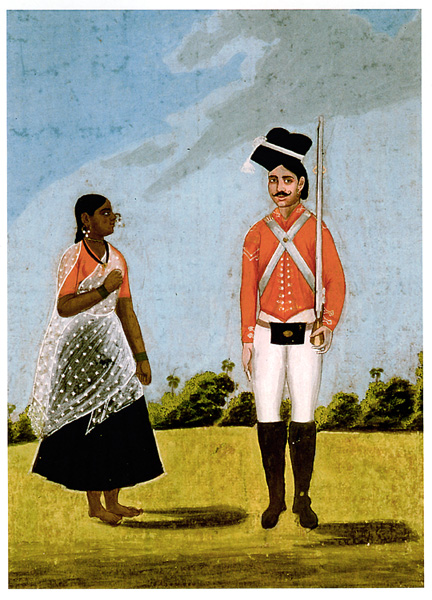 Indian sepoy (infantryman) and his wife; Company School painting,
South India, Tanjore artist; late 18th century.
Indian sepoy (infantryman) and his wife; Company School painting,
South India, Tanjore artist; late 18th century.
From an early period the East India Company raised its own army, which evolved into the Indian Army.
 The youthful Superintendent of the Hill States inspecting
with local Indian officials; photograph courtesy of the
Centre of South Asian Studies, University of Cambridge; 20th century.
The youthful Superintendent of the Hill States inspecting
with local Indian officials; photograph courtesy of the
Centre of South Asian Studies, University of Cambridge; 20th century.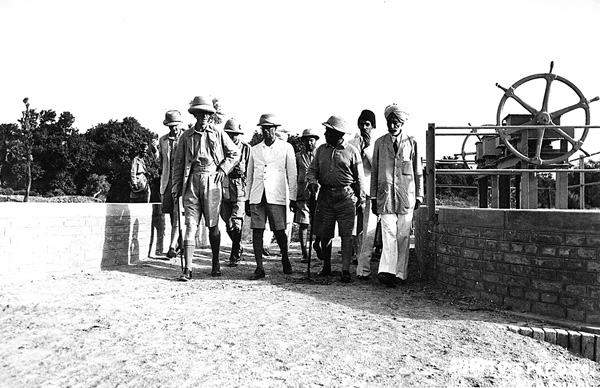 The Governor of Sind inspecting a canal project; photograph courtesy of
the
Centre of South Asian Studies, University of Cambridge; 20th century.
The Governor of Sind inspecting a canal project; photograph courtesy of
the
Centre of South Asian Studies, University of Cambridge; 20th century.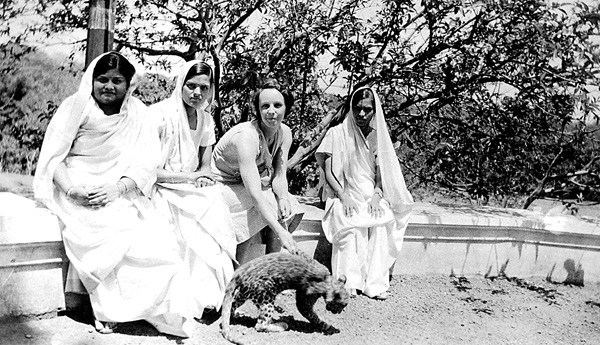 Wife of Indian Political Service member visiting women of the royal
family of a princely state under her husband's direction; photograph
courtesy of the
Centre of South Asian Studies, University of Cambridge; 1920s.
Wife of Indian Political Service member visiting women of the royal
family of a princely state under her husband's direction; photograph
courtesy of the
Centre of South Asian Studies, University of Cambridge; 1920s.
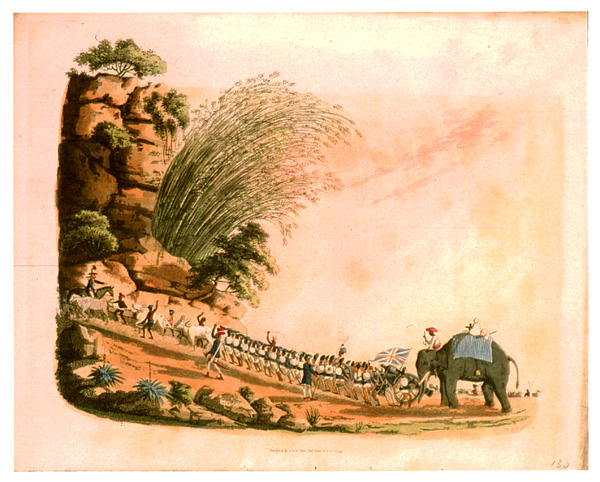 "An Artillery Elephant on Duty"; hand-colored lithograph by Captain C. Gold; 1799.
 Practice firing from
the walls of a fort on the Northwest Frontier; photograph courtesy of the
Centre of South Asian Studies, University of Cambridge;
20th century.
Practice firing from
the walls of a fort on the Northwest Frontier; photograph courtesy of the
Centre of South Asian Studies, University of Cambridge;
20th century.
The Frontier was the loosely controlled area between British India and Afghanistan inhabited by various tribal groups. The British and Indian armies frequently operated in the region to maintain order and their small campaigns provided what was considered valuable military experience for the troops.

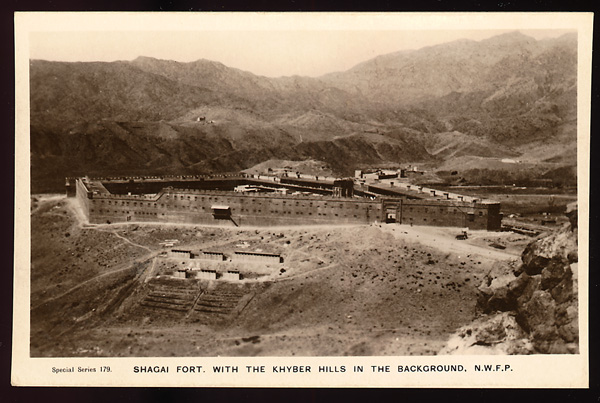 Operations and fortifiations on the Frontier: "Convoy of A.T.
Carts from Paiaza. 100 Yds. Above the Barrari Tangi"; postcard (Simla:
Army Canteen Board), 20th century; "Shagi Fort.
With the Khyber Hills in the Background. N.W.F.P."; postcard
(Peshawar: K.C. Mehra & Sons), 20th century.
Operations and fortifiations on the Frontier: "Convoy of A.T.
Carts from Paiaza. 100 Yds. Above the Barrari Tangi"; postcard (Simla:
Army Canteen Board), 20th century; "Shagi Fort.
With the Khyber Hills in the Background. N.W.F.P."; postcard
(Peshawar: K.C. Mehra & Sons), 20th century.
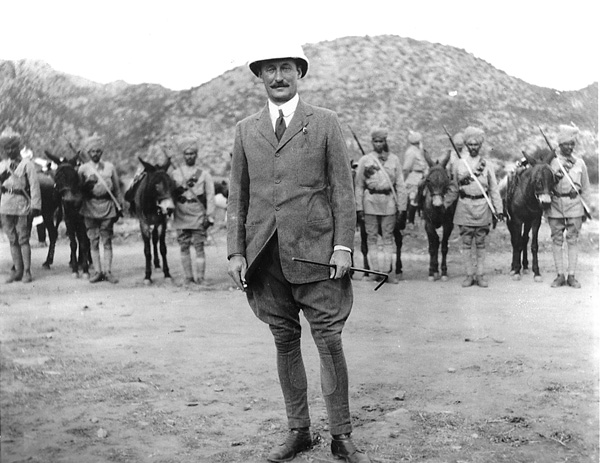 English officer with his men, members of the Frontier Constabulary;
photograph courtesy of the
Centre of South Asian Studies, University of Cambridge; 1912.
English officer with his men, members of the Frontier Constabulary;
photograph courtesy of the
Centre of South Asian Studies, University of Cambridge; 1912.
The Frontier Constabulary was a paramilitary force which patrolled part of the Northwest Frontier.
 An officer of the Survey of India mapping in the Himalayas; photograph
courtesy of Major General R.C.A. Edge; 1930s.
An officer of the Survey of India mapping in the Himalayas; photograph
courtesy of Major General R.C.A. Edge; 1930s.
 The young Maharajah of Bastar with his British guardians; photograph
courtesy of the
Centre of South Asian Studies, University of Cambridge; 1937.
The young Maharajah of Bastar with his British guardians; photograph
courtesy of the
Centre of South Asian Studies, University of Cambridge; 1937.
A significant portion of India continued to be ruled by Indian princes under indirect British control. When a minor ascended to a princely throne or if there was gross mismanagement or scandal in a princely state, a British official would be given more direct control. But normally a rajah or nawab had considerable independence to administer his own dominions under the influence of a British Resident or Political Agent.
An Introduction
Acknowledgements
1. The Passage to India | interviews
2. Running Your Empire | interviews
3. Life in the Bungalows | interviews
4. Imperial Diversions | interviews
5. Never the Twain? | interviews
6. No more India to go to | interviews
![Image result for ]An officer of the Survey of India mapping in the Himalayas; photograph courtesy of Major General R.C.A. Edge; 1930s](data:image/jpeg;base64,/9j/4AAQSkZJRgABAQAAAQABAAD/2wCEAAkGBxQSEhQUEhQUFRUVFRUXFxUYFxQXHhwXHBwYHhgYFxwYHCggGR0mHBcaITEhJSktLi4uGB8zODMsNygtLi0BCgoKBQUFDgUFDisZExkrKysrKysrKysrKysrKysrKysrKysrKysrKysrKysrKysrKysrKysrKysrKysrKysrK//AABEIAMcA/QMBIgACEQEDEQH/xAAcAAAABwEBAAAAAAAAAAAAAAAAAQIDBAUGBwj/xAA/EAACAgEDAwMCBQIDBQcFAQABAgMREgAEIQUiMQYTQTJRBxQjQmFxgVKRoTNicrHwJDSSssHR4VR0gpOkQ//EABQBAQAAAAAAAAAAAAAAAAAAAAD/xAAUEQEAAAAAAAAAAAAAAAAAAAAA/9oADAMBAAIRAxEAPwDXompEaaTEupUY0CEj04I9OKunAugZEeliLTyrpYTQMiPTix6cC6cVNA2sWliPToGjrQNBNHjpytCtAjHQK6XWhoG8dFWl6I6BGOjA0qtAjQFjoimlaOtA0yaHt6crSgNAwE0ZTT1aTWgZw/jQw07joVoI5X+NIKakkabZdBHKaSU09jpJ0EORNMsupci6juugKNdSkXTSDUqMaA1TTqpowNOAaBOOlhdDSgNAYXR4/wDXOgNKGgFaMDQ0egLQ0ehWgToiNLrRHQI0RGlVoq0BaBGjI0NAVaPR1oaAq0qtFo9AVaLS9FoEaGlaGgQdIK6c0VaBkrpt11JrTbDQRZF41HYalyaYcHQFGNSkGmo01IC6A004BoKulgaAgNKA0NKA0BVpY0WlDQFWjrR6MDQEBoxowujrQII0RGnCukkaBGgFJ8aejgvz41JUV40EVdqfk1/ro/yn+8f9P/TT6ODdftNH+tA/+uq6brsCJK8jqkcRAZ2ZVWyL4JP9tA88BH86b1UQetNtIZwGUez7VH3IqkMisyhCGI/YRzXg/bVXP+I/TxGr+9bMqsYl7nW6tW+MgT4vwpIviw1ej1WdO6/tp2xhnikarxVxlVKfHnww/wCgdWegFaGj0DoE6IaMjRaAaI6PRaBJOktpR0htAxJphhqQx0wwOgehGpCjTUS6kAaAAaWBpIGl1oC0ejA0K0A0egNHWgMaMDR1owugA0qtDHShoE6SxI5FX8X4/wBNLOiYaDOld+QEEyJivLlEbI/ABNn7WxUX8D7UkvQOqSAl+o4sQTjGHCqT8ArgSB96HPNDwNwdJOg5T1z0LvVgP/apdzRtkDS2wsFqDOcrrkeeTwdc53/pvcRyTL7MxSP22NRSAJkO0sCO2wDzr00dUOwFdR3Y/wAW22T/AOTbtSf9BoOE9J9J7jcPgkEh89xjYKORl3tS3fPnV1tfwv37lQVji85O7qRX/DGWazrvGgBoOa+nPwp/L7iKZ9yW9oq4SNcP1FNgZMT2V8VZsjga6botHoBotcw/G7ZSLFHuI91OlMqeyCyRknmwwIGXF0bJo/bi9/Cvd7p9my73IyQzyQhmOTFUxvJucqYsuXzWg2WhoaGgLRHRnSdAR022lnTbnQNPplzp59MSaCZENPjTMWnxoDA0daGjGgFaOtDR6AAaUNAaWBoCA0rQA0oDQENHo9A6BJ0k6WdNnQNsdIJ0tjpsnQDVR7OO/wA+P1NoVr5uKUG//wCgf5HVveqzc/8Ae4P/ALfd/wDn2n/toLHR6ynrv1Y2wbahIjJ706o5o0F4sAg/WchQ5/nWr0BjR6IaGgwH4w9Dm3G0RtuhcxS+6wUtme0rcajzV2aN9ooaj/hhseoQJ7crxtG8pZgyTs0ZILyH3QoSRixUfUwyJ54I1Z/iH+IsPT/0BF787Jyh7UVDx+o1c3z2r9jZHF8+i/G3dhxe323tj9g91TXxTZECv6aDs236rG8zwg96Krj/AHkPGS/0bgj4tT4YXO1wL0Z115HXcKxO42jEtAFU/mNtJ7aOqUR3pGgoAG6TXedvMrqroQyOoZWHgqRYI/qDoHK0k6XojoG6022nDpDaCLu3YKStFgOLB5/jiz/lpgOGFjxz/wDOpT656PUcOw3W5jlnDKxR1TtpGoiQAAjC6Xt5+92xADpqDTg02mnBoDGlAaSNLGgFaGgNOUNAQOljRVpQXQAaMaBGgBoD0Z0K0CNAljpt9OEaabQUXq3rH5TbtN28FRbXQv5oef8Ao/GuSelvxQ3s2+28UzxmKaZIyBEq8McRR8+SNdT9ebeCTYbhd0ai9skkeQw5jKfdswKHyePnXCvS/pcz7+KKCYMsRjlkc5QsqiTuEak5FgKNrYs+RoPSN6g7n/vEBr9k4/sfbP8AzQamZapuuyhZ9iS5W52QV+4sjDE/ceT/AFAPxoMJ+LWyhRYcwuEkyK0pAdkQyZzEUMwxLCzfIofOunbLexzIJIXSSNvDIwYf5j/lrJeoTt2eQbgRM0ALh2UFvYlWQsUwN2MWQm6pLPnXNvwz6skPVhHti67ecPHiSx5xLKwDfIZQATZAJ++g76XogffUXe9WghFyzQxj7vIi/wDmOs56q9O77cc7bqMkHBGITCxdgF4iCK/4b5865L6o9F9ViDPuCZ0FXIJ/c5JCqAshDsxLAABbN6CL68bcbzqMrHAh3KQHKNFaFWYRkEkZWObPJv8AprMrsSVJDxkhscM6cn+AQLH/AM6Ld7N46yBGQsHmj4DAEjkqbU14KkfGo7kH40Gi6b6UaTY7vduSnsYe2AUOZzxkBANqBa93j7X8d3/C6Jl6Vsw5JJjZuee1ndlH9ApAH8VrzdtmRY5WLN7nYqIFtWU5Zl2sUBS0Pkt/GvVPpyEJtNsq/SsEIH9MF0Flojo9A6BsjSG06dNMNBR73fyGQpFGxKhWJbEAglvPNqDjwRbeTjVXgvVe7ymGfbKI1EkayRpjfctllctw5F0v0/Pxb+sOp7ldzHGkbKOGQhsz+8FnRfKWA3yQY1FEuNZKDqPUZHf24EeRaEhxByFtg9PIrLYBFHjsugSbDuaacGm0PGlq325FXYI8fH/X8aBVaUNENKA0BgacrSV05oABpWk6O9AehoaPQDRHR6LQEdNSadJ01JoOJ/jj1pvzEG2BIREEzD4Z2LKt/fEIf/Gdcx2nWpYdym4iapI2tT8eKII+QQSCPkE66l+P2wW9rOKDtnEw+6rTKf7FmH/5jXHHFHQepPS/X03m1j3C0oZe9b+hxw6kkDwfn7UdU/qbr+3aTZ+y6TyRbmNxFEyyMUYOjsALshGdv4wJ4q9cg6N6M6nPGqRKy7eYLJZmUREECmdVY2arjEsK8ca6F0H0g/Ttx0we4HUbjdZkArcku3kxofZVhqzz3nxoKv8AFL1PKj1DAUXAr78kQ8SA5KmSViwX5POLcdt6xn4Xxl+q7Wvh2Y19gjknjwNdc9cGMCWV+5HSGGRWQY4mVVVyWHJQzMwW65bweRivwK6aPze5kLAtDGIxiQQc2NsCPIqPg/ZtB29dUPqdA8m2QntjkbdyLz3Jt1tbP2954jXzX8HV8usdPMdzu5VU9iD2mIPlSXgRSK4ynl3F1/8ASx/fQc5/Ef0dLBBDKnfHto128tA8OQJHmP8ADSzSAn4xX765sRr1hwduSaIcyPzR7XZmW/4xYD+g1519Q9NhWVzGDEmdFWaM0GJAlRVYlUDBQfPnivABv8Pulw7rfwwbjIxyZghWxsqjMoJ81a/HOvT0EYVVVRSqAoH2AFAf5a8wehHMXVNmG7SN1GjD7ZNgR/qdeoxoFaLQ0THQMTblVOOS5E0FJAtqsL/UjmvNc6rui72SSNffX25sFZo+TjYHBNAFgbB8f0+TX9S6VtZ5I52XIq6zIyuSC6kYPwaIxBHI4IA1O3k3trIVVmKFqC2WYlQ4Hn7mtBXeodxLC6ThHljQ98cdF8cJRYBqwC4NX9zeud+rzBuninTcflg8dgKEBIBIp8ZFa1IP1D9xonnSJfxGaX39tuUglDWqlVnVScGvgFmK5gUDViya8aqeldYgRWK1BCzn2o7UnirZjiz5EFLDE+OCQeA7jv8AqccK5FjjTeAXIOJYUo7mNftBvkaqtnv2lEQjANe2pBBZLC5GQBmDWGKjkEiv7jmXqLqku5lVkABCrJiA4BBXPKQeGCjKyASVNc1qZ0vrE00kM7TCKFSaDOY1ZaQA4rQP6jX5UAV5Aag7bFHV8sbN8m64AofYcePuT99PjVT0CRnhV3bNms5Uotb7aCkgCv51aA6BxRzpekKdLvQHoXqA++OYArDwW/3rrHz/AK/HHm+KHqXqAxzIMOGk9tT3v+o6nDsWibxb+Ks2NBrgdBmoXpCNYB++k7lMlKkWGBB8+D/TQMbXqsUjtGjWy8kUfHHIPg+R88am6yHTpxtGkiUFiMCzP23GvaXsLbuWy7eLIsUDq469uZ0w/LrkbN8BhwCe4WCQaoYm8mX4vQWpOmpCNFtpCyAmr+ascjg1fxY0TPeg5d+O5T8ttgwBY7jt/wCEI+fPmrKeP41wqc9xrxr0p659IDqEm29zL2oV3FhHCtm/tYEWpDD9Ngbr6h55Gudeuvw1g2mzfcQSTFkxJDmMjEkAntQEHm/Og134Nb/3emonzA8kZ/pea/6PX9tXfqpmEmwKAE/nR9RIHMG5HJAJHn7HWa/A7p5j2Lykg+/MxAB8BOzn7HIN/ataj1V9WyP230H+qyL/AOug49+I3qvcNJPs3SONT7QlCn3LKkumL0KFOt9objn7DRfgBAa3khHBMCA/yBISP9V1mPVfRx+f3W4kNxJ1CCOQG/olDOxY/CgKF/v/ABrd/gimO33QH0DduFP3pUH/ACr/AD0G8691Ndrtpp28RRs9fcgdo/uaH99UHp6BoNgJXy9yUjcHK7pF9yJT9mwiUkf42f76P1pD+al2mx8rNL7044/7vBRIP/E7IutD1WPIRj7zR8fxfeP/ANeegU/SoWRY5Io5AiqozRH+kV+4fxrh/qb0imy6pC0uDbSXcqShKgqjPzGULZMqqQLHxrvmub/jRsgdt7pB7QaIJHdxiTR/jQZjoPtbLrh4DIsz7RiQWKFx/wBnYE2b7RGT/usSe7XcRrlv4gdEKBTHZfd72ItyR3SJGg5BFVIgcH410TonUV3EEcqgrkO5T5VwSro38qwKn+mgn6ZmlIZRjakNk32IxxFfzZ5+Mf507pLsACT8c6DPep5Fg20k0aEtErHBCq2KNryCKIPim5o0SNcoX8VJi74QB/c9jBCT2FLzC4glwT9JPgAA5Veui+op0ncxw70xM6VjGI3Dra51a/UVYDgkUSSLA1zDrxdY6bZxVCaWQvLEQFjIAjLOHcLgB5BONYA0QGJ3Lj3SXUcsSyA0LPJxIJNc8G+dSt2u2IUiR1clslSJSgANJj+oDZUWeTyfN3pE3UEZ5WEdCUc2TIyEkFmRn5JNH6rNMeb7tIj6POyh0ikZGumVcga88rfI+2gu44f0wyoVjDK4YI7ZSVWJYXRvLgVy/wDBA6D0TpUkZ92ZASnI3BIsnu7spAvtcspIHJKClYWTjunb78o8cUYWYElpCwBEbMq0sTMFCuApZjxY4teTrc7LqJ3ifpvIIV7f8NSMASmUTXwX4GVcjg8UGm9MdYdyjNN+Y94CgorDi8iuK4LeYOXPatfOtTtNwWDEg8MwHFeOPub5B51znpPottohlhkkM0SspQqJIpCCxUBEfOgGIU3a8mjZB0MnX1kRgyyKU9tX9pjIoYlSMHpQ3JA5rg8+a0GvjbxfH8aj9SlcACMWxP8Al9r48XV/xqLvOqLCFDmiUJDcc0OaFknyD8+fOs9t9/N+YnaT3BFSYXwOxe4csAGZ7vg/tHgHQPb6JoJEVB2zNjJKXPuWMyqhqKkhn4U0pLN8CjpNtFGCopTiqlCaJA7qo+aHx/B1kouowSAZkWvuYhslbFwMqBU2hvGz58eSNDa7ggyYtiGpodxmZlMR9sFkY5AWXFA35qzjegvet7vdg3tkRkUchrVmPORUngBRXBFlmHICnKf0reFogzsrUqlnX6TaKxZaJte7j+NY4dZVYNyWzmh9xklZzaotrEeSxNBRnZBvP4rjRjrcaYC+XkMagMpJanYL9XBpG4P/AC0E3pe/G4QOUZD/AIXrJTQJBrwQCNUHqX1LJtpRFHEWGMQyCsQnuMUjJ/xEuKCi/Isgc60Um9RcQXAs0L+4v/21Qeo91I6SAKlAcq5ILKjAvyRigKngk3bDxYOgmbjfPYHuKv3Bpcaqwoolm5rkVzfFAak9Js5MY2TJmNlrsdpDVfaTdEf7n9DrPdM6Y7ztM1sWYEFlkVaBOQXuJjJAoi8TX0glidkdBF35/TeiAcTRPgH4v7i9ct9d+poF6c23A3EtRLB75iYxmVVA7pDSluCTjfOth+JPuNsjFEyq24li2/cMu2Zghofemv8AsdQ/WPSYE2+wiwtIt3sY4wS305qnNHntvzfk/Ogo/wAFZ3XYyJIsi4z2hZWAKSBfpNcjINf2savfVLM35YklVG/2gqiDfvBQVPyCCf8AMa1EkXOXzVH+RrCetuvwFYF95EZN5tmaNm9p6SZbyRwGCVbZeOAeRoMP6m6sr7XqwKkF9/twpYgnKmv6eAKgav4byTrb/gqijpqlfJmlLf8AFYH/AJQuuberdoqybuGArP8AmdxFPEIXWUgIsxcOqEsvE5qx4B+2rn8O/SnUY1lnjlO0zXEK8ZcuPJbCxiV8qSLNn4J0HVelQXud1uJOCcIIweCIY7JbnnvlaQ/yqIdTzuFleHBg6j3ZMlIYdo9sixx5mP8A4T9tc62E0u7V1QNKHIRpCTGZBEqkui4hYy7seCeCOSKKnUemfTzw/qSvGzl5H7UtV9wISqlm4poxbKFy4JF86DUpKpumBo0aINH7GvB8awn4s9Nn3m19rakMY2zkQNy4ohY1VbLGzdGhwP7aiadIqfB2LGmKLkaAJtq5xHi+a/zOq/rG8EUTvigLZcCX2QTfFylRh58/FGr0Gf8AVabuSLpbKskjRPtp9yQuIGGLMXU1RvwvnzxxrU7IezvJVTui3IMvaQQk60r3XgSLi1/4kb/ENUW+9UrEuN7ftx7pJWCYngYMAxY2DQrwLJHgQd963gQwwiZEaSNZjKI8I6bwCWIKN/vMpHNUD4Do4cWR8gc/3v8A9jrM+reuflcLY03aARWbFlATL6QeSbNcAix51z71N6umNvA03tw5uko7kyyUIS2ODLlnwCR2gEXerCL8QNtvtq0W5ZI3cYyxnJSEH1FWxORIHCqMieBRIoE9Z2m2m3EbKsu33MSyAJJEQhjRZMsShxosWN88hiOPNP1fe7lpG9yBmVHGVSfUuUoWQqlk2oOJN/Sw57SuyToEIhJjDElFBf3WPaMDmzgH9TEZClF5N/jJ1R9c6C0xjBmPvF+AmYdoCsooFh+nasBbDtxY9x8hgNwu0SRJ4Ey27WssEwyeIhkzw5GXBBVrvkgjzqr69tYoypgkVszLkitlhUjBBa8UUxI5PzqR6mXbR7mVIDlEFCjDtUOAOAWLF1DeWNEm6rg6n+megGdGLwSTKtKjLOIwPJZBankE2RxRb+dBWJK+OCCRUYssguwx4ID1XN/ccfHzrqHpjfyKyrGFhi9oPIoZpDkgshGa8GUAWjcEFiB8axPpqD3H9uQOFEgkmYKTcfCiuQw5yOQFisr411l9yIlxjAjBHCklQDZsH4HB8gWRRB0CIdrH2xITGAIpaxauXtmMgItuwjgj5NaT1BnmBjEdbcssJIJZi48mMxlqKgEhvmjfIrT/AEfevJMUZsjXfJGKUDu7KPZkGtixANECnAJEreiaGEvE6zqFBRP9nYBsAFeAxUn4o8cAXYV/RZFcJBLIhDQk4thk0QHYQihQrZyFWHm0Qj6iVtN7M6CV5E9xEjDKlZBixcYrfjECmJBFEE+CdUsu0BkkkcK062EkOCUxHcsQY5CyT9Vggf4SQtPN1uRYDKqrnlfa0S4dkczKxD05YgEg9xDPxxwFx6kkkkZW5jkiWJ43CtaPIxj5RgWkH7StGgT5JGoe03kyLDFLGiRByiqzsT7Ua8ENiQ2QSQqoPAItuBVI/rDcA08CJm1EojEo3YYkm+lMgJI7GRPONqTxZeoYVdUmEt9rhSDYj/Qcs1q4VSxAXKiFv58gKbqPUpFjlk2bxJFHM8h4ZS5Ul8RTNYUIAOVrJV8MBq32HqGWGHKdUaL2huDjimJZmEa4oxxPto3b5DVySdZ/1GsTAR7bJCGhf2+bO5bMVZHHcgPDBTyQDfFj0x4zs3LENI0X6cZMeIkSPL2AhUhMJJSbYk1EtntNBf8ApTqO6eMyOzK2UgkZ5MkRQrGh8uAUJoH9ynKr1L6dO24lG4ljUiB2CWrE5MEtgAO9QrSKCLDFh/hGsts+vTSSR+885MrJI/5dWxpJI+35Vo/1mzKM3CgEA8at9p6j2oJ2+2kiNORgzyoSwYh6cKwIKgvkVa2djlfOg3fp3qglVuWytmxZMGVWtkJUsTRHg/7pB5B1bQzWBZFn4/p5H8/fWOXdMixSLWbpJK6L7jsFBXJVNAnH3WxVkIPNEcA2G96gpgaWIgYhihkUx4+BkBKAbJU0Wrg+RoI/rYO246aqDIjctLjx/wD5xsQefsWvVF6163N+ViMsUMe4TqEJhiEpcPgwxb6VYgtd0BxRvnWP9e9dZd9tDuFmZFQu0WeLd5KgAKWUMuCngmyOfvqy9cdJm32228/sSlhX6eJ9yiBYcyKpUBmYGlYNSkeNBf7b1e8/T55tyEgMUmDmpAMckAdQCxblvhqJoWL1S7f0yu5VN7v1BlaPJdqMxcSgZOadWEjHkljQDdwPnUfpO33UG3w3SGDaiSONIoxFLLK9mk/U4xs3nxRUEcCxfjdQ9Ujce1KsQV4kYkKzFSC+A5UqMQLLHKnBWgdBN2oG0PtwbWOMuRXtBsQWCV7j4ee1gccvCmjelbYypS7ncojFyoQqr5H4Z2UJbMttSgVx8Agt7nrY2iRKUllYvgTHHl20DQFi6BFkcHFj81pHRd8dzHLKBKlM+I9trULV4oqrmRiVoHzx3cWF8m8K9saDkrwwYE3YOXBrxfzxzwOdJmlkclVUKpDHK1+okBVrz4/j4rjVf0bZGGwZJXMju9ySZOASrMApoKOQO00KRj5IEvcSkRyEr7SqLV5as/LDFKsYnxfJPIsaDF7Ppb7WIQb/AHD7ppCuG3jjd2Uhlv8AVAyAAYN8EY5LRGrzqWwX8q0KQxvGMQEEmCcC/wBRyXZiTR5Bu1LcCzktt1HdbreEQTs20USBsGEQXNTbOslyEWSMjySrEV41ZdL3Ue8wkYqyiWVljksEqOEdUdDdkMe1lClFHJDWEX05HtIt1Ls5FQ5HJQ69jMzKyRoDkrKAuS91klq82da8n5cO4RfPJ/VkKgt5az4Ac1Eg4xAHkVnutMizQbn3SpEZWJC0JzsyOGZ2NplIVBYHuFAedM7zrriFkkwTcvYVxyhbDhwHJyvOsWH0q3HC6CfuJoZ4meSJ4YZQHZrMdlcY1LhhiRhLG2RFABr+kap+tjp35bblwRiUkVVwVmRVJCNKtKBTGgGHIIFE6d6MnuxiOMtIEJizF2yI1yAyK1nLtAK4ebIYitV/rxYYi4lZpJZELCOIJEiJ9KsxvJwtWFJpm5oWdBG9b7nFG223kUJGVX2lJR/C4pRe2UFmYkgWR/Q6z8nqTeNBLt+WOapJMpcuV+kRH7gkcmrNAEnjT0c2xi9t9qm6kZhi6M6r8NmGEfcwxrwACCebFC62fX9wu4X3o3g21EYqryFBIO3k8lg3ziSpNV4GgwvTFlycRKWPtvmAORGKL/ytVyRz51cwdQEigRoEI5YvO8l3woUF0wAVQP3EirPjVn12cLOku0HuWwxYNGwL43IlXkRjjyCPqfyXvVN1vae4sLxQYqVN037waZaLZKAR9JJ+r4HGgt/SfVPb/Ms7Fg0aA8kv5anU3wwDkcA+f760Ow6vQhV5keP22uORWaWJR5GQ4dsVx5xugReJ1n599+ZYxRJGHlXJSqwRiM33V2rmHBo5E+b+K1N6v0zcM8TlQwMUa4BUSlA5VL7CS0gI5JJNft5DQj1EJLYmSEK5kDqncmLlCS1nK1OLRhTzYHg610vqqFoocFab3LVVHY5CD9U05UoVANj+a8XrmUe7w5Y96yqrDBAF8lggm4DkhSGXH/aAX4u7hnaSVlcrEBOhTISwxqrr3sWIyBZ0wCk4F8gGYkaDWwxsiyPcr07e0wCAmPuCowwJMfIIOJDUD8ayvUOoMp/VRwUEkkcl7ch0VCRlRBLAXzkptRRANa1G/wCqpKbVqwBSVQMvcQDvQqQLwcgih8sOATqg3sgO1V2dACF92UAhmkUEtEA1nIUDgT+2jwSNBAn6KrrEVMoP6bIGlyzYYlgWVVVlCOGMhUtTSee3UBuqh4vbNy5yRxyCwfahBcq8NVWIIaiB5ogFTWkfc/8AZXO2jLAgfU70ju/tNQCsSBb2VAxCqAAANZbqnT5I5sJZFxV3Aky5MYMrISe9zgXKYhflBfjQQtzFIhUMVaGORlYhF4aVmQmVWxLrQAoUCb8EcW3VpUDfmFIlKGOMMC8So3J9ym7WogLiT2nHlatqM9QWeR8A5mAkEXCtyrCRpFZeVJHvAUvHujntGoOw3UeQRz2SokZKGxDFG6sGsCj3pmePHP7r0F1slk20bye6BJJEv6bLGQPcNhlKsaOWTcAClcsA1gYjdx2zkHKrZmNDKzyVHPFnzf8AOtZFv4FEKZqI8V9xWRpFuyZW4PdlbgEDimHAJGtNuNnBMJIljVAIkZTgFqJpOWUKCpXFmUFWs93JLWAwvRt9uZJI9um49hhxlI7KMkWkQ8HEAKBVeSSfiug730/vWRIlk20YIImncySPLgP1H/UQsAt8KCLL8cXTsnTIkwl2q7b3jEZRJUj55vZIyoylgFFMSVOVAk6uOoTtLFGcC4y7l7omRSkmJEim+WpTizeK+50FP6Rh3kEDZ+zJLHXtsSDjGisrQXj2FWVSSOOcSQfFn1g7/cLEolj2qFZPemRpDQsBAMgpD5fYqaUnwa1V7vrUaxor4FcBUQKBqagWkea8xkUJWv3teVC1jrsQCwxQ+8ye03tqSvdmc1PtKVVRgAAt5VXNAkNSYCwjAYS+yQfdkKvi1MHZ1T9xRuBxxIdZrc7lY1VhI6E1CULK4FFbYV2kkHuayOzixer3c79IcWYIEZ3kaO3JVwCyM18K3zi1U1UbrVD1/qKbaVwXzjr9SL2y3Nl3PabMYSrSgBam/I0C+u7ZFOZVW3ACYKPdkNMcj2B1XKhWWIssTd8an9Gl93bKCwOMao6OATWABMpsHEsPH7uf6DPbAZzSSxSlF9z7MqZMlKwtlcjBQQTYLKKAoDUzaxCdTIJXkkaQAqQ+AkBWnxUkKw7CCPF5c3YCw2PUSIhBsTC0idncjrEgUgEFkN58qBQPIJqtVeyE8krw5owieaOQg5s0xCl/bypVVXICi7xAurN2E3S7lRG7kjdCIlLUi0723tkZ3LiSGFEEE3RIsIsIEd8o1PKvJ7JW38sxxBJF1jYN8CyWshlpvRSSSrJJKyTL3XCGgJuwArMX5UxsKABPP9qv1D0GBtt77GTbvGW9tmk9wmpGCChwGwXKko91nIg6veloItxK5nlZmFgSYAKCoYuSqKEls1ShuJgSCDlqk6ptVEZZ5Xyp3Ys2VDsUoFZA+DROAXYNWfLDuBCo9Ddbcn8qxRIWVlMhQZckFbckhKKg3RAxuiedWw3pmhllUCjKQSrSkZ5rwQqJkhMq2fLWRxiukbbo0cUKTyRukYJWRWxVyWyAJZGXEC2GJ5+nGzRA9R7aJ9urySusCEBY4lUoF4FIqlQGYqBkxPn+ASCPQnqB2uMnKQvd2iqFAAo9lEE8cBie+qJBNn1bpoZJ3cRpKLQFnUd7K49srlwUW6WmNXjYN6ym364kW29vaxKrRkNO0jd0gIK44fuAyJPwtD+puekdZKI263PtgzuxGSMhLAAILxvEYobUkHyeQx0GR3PRNxBIwQOtP7QyqF2D2FuNmyxYDxyKPPkXtPU25dVgjkLu8sTLucBI7BaA/SQuEQMUIL1yVvuA5o/Vj7iCUzpuCPeVWYCo2Ut3CMX3OFGPd/HNVqp3HVp926GR2JyBLE9ockDPFFoUtWADwv8AOgd6wxki95psmvBVb21YqnuAmQJebY425PPA7vIrpurysSQVQWTiiqos+T99X+02CRwh5FikCqWSSMlHdVUEqtMAwzfBmZS1BgOVoZFvPIr+Pt/Gg2/R4oYdyiK0ioS3Nq9sB3fsFBXRe6/5/jVoHcJw4WSWUs+KkSCBsVaQEuHApS918HkjnUHYenpsI13BQorEjuDdrYj2l7Sc3duSR248fOrHatAm4Mm5kMmC4k0gDGmyaZOGC5cLdjtHJHgLITsShijM/cM3YWA7UASoFs4VKC8ju5uhV/uZXmR5zaFAK/SJCqApciwQ9qWFEOLxNCjVBu95K8rRxxiRVkJIjUklgQ6qcTlwrLZ8DIefpOhmjSFY2SNsCxZ0kfLiizYmQliQeRRA7W++ggdE6is0s0bxuzSTRhg6WPYCqUEf7R3YPQoqJFJ8E6Y3XRzLvgY2iVzIMEZRxElu2LG8S8iEB1BGMh4+NOdEk2g2hd5Bk+TlmkxlCtjEGDFy3gAKfHgA6V1T1Asnt7qLFRHE6oCjI4DOEtTYAAxZQDXJ/jQSurzq0KMAm2VCEliYRqa7F9nuBH27lIyGBBYVqg327WYrHlFFKDKIzwzRAuhqQqaL4qRX7CEXk3qT1RB7KzhstwPaR2LZKWIFwyNYJUsRjZFEA/1zvWhKr3U06pGGWdB7TKGLq6nD6+8eQOMifm9AzFBNEJUMjxxxr7YDARgSsSjuqK1EVHVnyLagaqHu+hxxhnUzNgqOIwKIY+ElULSGgC3dYJoA8andE2826dXMSDFPbBZktVWQZHAj3CVXNbqjkfBFa3p6IqiUB1jWmDUip+q4r3C7cyMFegSDy58kVoOPxtFPJIXjlK55XkLWKyKZjwvlBkQRd0BrR7TcTvuvd27xKiKEVnxZiECjBVj755OLAAPDA2oY6l7z0dAisqwvLKkchozUS5K+1lHYYUrklrUfpOStavOl+nI4HWSLZD6UcSLL7uDEA5IZCFrEscrIsCrPGgs9xvNyjIiilao0r27iUrEO5cu45WRQNCTkiqaPIyGI3M7olthEBEqj279s4Bi3MbsVWz4B4DWo9SijUyHiR0pvdCMKbIqjeycSB9PPIDAkjyanpXU5fch2xOGTNI8ubKQ7KsjgEWHbNwCKBBejl50Gf/LEOjIFstND7S+3IWyGUTIhoOEDKxL19Kk8jjd9OxgiZYMRl7oVWyyeW67JDYINcZWTjlVAnWM3fQpIhJuRhIO32y+aYg8O3tFb+nFDfK5A/tBFp6U38KQgSujbhCRGLRR7LOGP5cFQoJr6Vs2VNgHgJfWt46MYpValcd7g4TK7pSl+AHostiyQLogkCg6pHPOWEgUiJyxV5SMSwJcntKunK2cjio5AyA1Yy9UjfBVSVi0te63thY2jVj7dlSZDwSFbm2PPbrOr1R9spjLI/uRyGg/+zWzSWLVjkziuQL8j9oXm867+ZjYosaxR4t7bEk+TiexlwBqGNbxYg3XGljcSk1HHHGTm0WRVvbdgt00argwVZajJJISq7Rqq2PVgYakjQEQYwe5gEkCFBzTC2Csy39rrmxqo2MDyyIsiiNGJJLZIi8Cza17QVStE3XYOR5Db7r1FtoJ4yZlZZEBuOJeCASS0hLMAxP0gcWf66e3XVLcl1po2UFaAEUfeMzyqyMWyANigRXhtUHpc7RS7SyiRl7o4nFRoDioeQBAqj9RfAJ81zwYnVeq7ht3EGiaNniKxJiKYuXCv3r3A3VsO22NDxoJvQJFm3aBFDdjGSUEguMgEiRlCiglKfAFEUMaOrl6djCwaOOFEIaMKyqcVAID5YjInyhGJKclh4RF05dogdEZ2YKtWznhJGCxjEDG75I4GQ4vRT7h3v3AXVVWggpCwMnYwyJ9wg4UTiCQbNaCD1fpMTQN+ZMaOxX3TGXCAoHNv33VZEKOLHF/M9Yo22+AjQoquIVa3V40UhGPbmMroXyQDjd5aZ3FNCySL7AWONnSwUVDmgxp1GI8VRofwRpjcb3Fg5a0xEjn/AGtMQDi2OQVeVIKsBZWrBbQV8vTYdu22/MGNjMjgZQllycoQWyU3TYkZEGibA8GVPv4iyrlJGsccYMgQLGV5Luva+NBCFW6ND6u1tUvTvU0fuAGocDTllkYul5e2XDMVAuRqoXVG7I1qdt1RJdqztJGyNgmTEglW7CrDJKJJxvIY5HntNhheviffTIqiv0lbllrhnDNyFYKCG7aJseORqJ0r03IZWVETcFFpijsqrI3CjMqASt3Q8EeeDrY9YleKTCfaK3DSRhGkDFFK45BAVEtkC/BIHji0ek91sondoXkhtcnEjMEUpkvtnNrDv/tKyJpfI5BCds+mIZWScIiTFSERnLGTEmUuQKjUgFQCf2rdkDVX1T0rAzHFQxVippSjUKrNIQBd334jL+cSdaLrG3paFBpjaBm9sXQAAZQ0jcKrFfkKT4FaxMvp6eWSSV124Z2IK5lQMeMrPBJ+QDYrmrrQO7zfws9blmaMviMVvIAIxam+i82JryoC0Dpl9hFisZW/akAI8FQxIKiSsm7ir8j9xFjyBoaBzokm6MMh2uRZtw+f6gDlAtIGdqFgg8rX1X/SyG0kjaVty7SAB2xLlyHDoeSR97PAAq/voaGgqdrv5ZHkSI8WQBiOY2tvLkkAFCyj71fArWyhT3HMQCywuivTAJQsuFPBzSiTRFgj5sEDQ0E0dDUFzI2XJKxRgxjBj4PNMSq0b4Nt99WPUo4cCZUDBVYYEWtEeMSabkVz4v450WhoBG7iRfeeOMMVQRxo1ZdzAZE/ZSeRQ/k6d6n05ZgVdnYLyqI7xCzjWbqS7Hg9w+GPGhoaBve9F/SEcKRQDhSBGp7KN0FYeSebJsEgjnUvYdPEKswLG8svcOVksxZj5JBJsD448cjQ0NBQ72Ub1EHe9RPOpNLHTfSHUMGJVWB8VV+W1m990VhSYwqhnEQ9tVWnjOQ+pGLKzOw/bRC/AJ0NDQCMiWSSRWplXOKJQShf2VMuWY71t8MWr62o1WooEbQxxtTF9u5QNkCiq7x0xWlkxVuOBVHySGBaGgo9p09Sm5cSMsUeIBAJxftKMiX9mlAthWWpXSulTz4xRt7iB1ZzZA7e0o6swyAyqwTWdAEWdDQ0FH1CdkmdXjjV1sYreAJHGKmxQDE1xyT/AE0/teoSEguUxfuZ2DO3YB9jY5IAo8XXC2NDQ0EabfTLLJLmwaQC3GJbvW1okDHlQLWiAKH21Y9AieeaOQmR2Q+5JNI5OMcY7saOTC2Hb80PuaGhoOmQ9VyjdsbCFkvz+oASwa3+kFseAb7uaq8t1/rKqyhi7AkZ4Ki5KAhXFmN0DKTRAJLeQBRGhoMrufUjFVF5FSQWN2VsmzZPeQSMvK8154b3fX/cEgIKqykKLLN4UKpewSLXKvFjxoaGgi9a2/tvRY96JIbABYvZ4CkrwGryPmvNavfQ28Mj/l2BcsUaPlAQFNyKGZSQrALYBXhTzfDFoaDpvVOnRzJOisMpBZNFT3fSS2NkiuD/AE+2uTdF6n+U3cg3GRTvjmVaJYqGXyf8RsEgjhzzoaGgkdd9Qy7wOU9yNFGRBlkeySoa8moC24AHwfvwjb+pZI4o026pCFBuyxLD7nEDmw3m/PwNFoaD/9k=)
[14]An officer of the Survey of India mapping in the Himalayas; photograph courtesy of Major General R.C.A. Edge; 1930s.

[15]
The young Maharajah of Bastar with his British guardians; photograph courtesy of the Centre of South Asian Studies, University of Cambridge; 1937.
A significant portion of India continued to be ruled by Indian princes under indirect British control. When a minor ascended to a princely throne or if there was gross mismanagement or scandal in a princely state, a British official would be given more direct control. But normally a rajah or nawab had considerable independence to administer his own dominions under the influence of a British Resident or Political Agent.

Two Ensigns of he Royal East INdia Volunteers (EIC's private army) kneel as the Chaplain consecrates regimental colours. Painting in India House Lib, c. 1799

Robert Clive 1757 Battle at Plassy

Siraj -ud-daula

political map of India in 1800

| political map of India in 1857 |

British photograph of Maharaja

British drawing of Indian labourers
Memsahib in a rickshaw


"Mummy and her Tiger", 1920
20th century: Leader and Sowars

INDIAN PRINCE WITH ENGLISH RULERS[ Bhairam Deo died in 1891 , leaving a minor son Rudrapratap Deo .During his minority the state was managed by government until January 1908 when the young Raja was installed as Feudatory Chief of Bastar.In 1910 a tribal revolt was occured against the Diwan and British government who ruled over the state.Raja Rudrapratap Deo died in 1921 and his daughter Praphul Kumari Devi ascended the throne in 1922.Later in 1927, she was married to Praphul KumarBhanj Deo,who belonged to the royal family Mayurbhanj of Orissa.Praphul Kumari Devi died in 1936 in London and her elder son Maharaja Pravir Chandra Bhanj Deo 'Kakatiya'ascended the throne in 1936 at a minor age.The famous Maharani hospital at Jagdalur was built in memory of Maharani Praphul Kumari Devi in 1937.Later in 1941, the Air strip had been made at Jagdalpur.One bridge was also constructed during this time over river indravati.In 1948, Bastar state has been merged in Indian Union.

Munshi (language teacher) instructing new arrival
Life in the Bungalows
Recollections of English domestic life in India present a picture of an existence both contented and full of difficulties, both luxurious and spartan. Britons generally occupied commodious bungalows (the word itself comes from Indian terminology meaning something from Bengal and referred to a particular housetype originally from that province) and commonly employed numerous servants to run the household. Yet even into the 1940s the house would not have electricity, running water, refrigeration; it would have been open enough for insects, rats, snakes and--in remote areas--even wild animals to invade. Moves to new postings were frequent and thus life was unsettled. It was thought important to send children home to England for schooling, so that family members were separated. There were likely few other Europeans nearby, so that people--especially wives with no official work, possibly no children at home, and only a menage of servants to interact with all day--might feel very isolated. Indeed, women who found outside interests--whether their husbands' work, local charitable pursuits, or the outdoor life--were thought to be happiest. "Dooreahs or Dog Keepers Leading Out Dogs"; aquatint by Samuel
Hewitt from a drawing by Captain Thomas Williamson; 1806.
"Dooreahs or Dog Keepers Leading Out Dogs"; aquatint by Samuel
Hewitt from a drawing by Captain Thomas Williamson; 1806.
An establishment which was an Indian version of an English country estate was an ideal striven for by earlier British sojourners in India, few of whom could have ever achieved anything so ambitious in England.
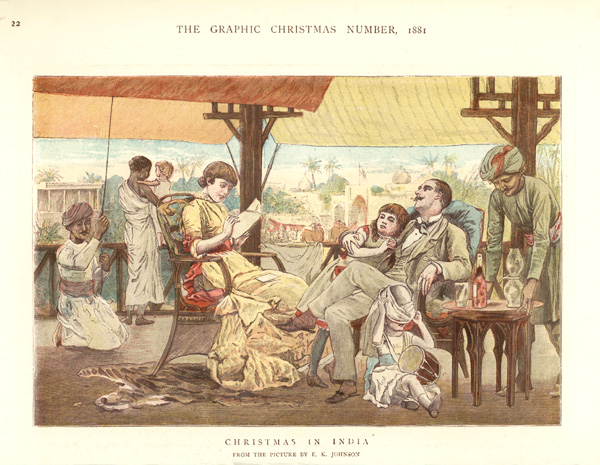 "Christmas in India"; chromoxylograph from a drawing by E.K. Johnson;
1881. An idealized picture of British home life: attentive servants and
happy children (who would be packed off to England for schooling before
long).
"Christmas in India"; chromoxylograph from a drawing by E.K. Johnson;
1881. An idealized picture of British home life: attentive servants and
happy children (who would be packed off to England for schooling before
long).
 Bungalow occupied by a British family in Ranchi; 20th Century; photograph
courtesy of Major General R.C.A. Edge.
Bungalow occupied by a British family in Ranchi; 20th Century; photograph
courtesy of Major General R.C.A. Edge.
 Tea plantation bungalow; 1930s.
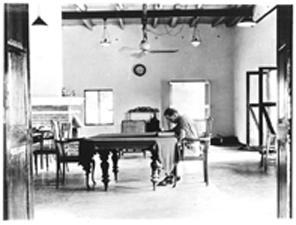 Interior of tea plantation bungalow; 1930s. Though large and sometimes well furnished, British bungalows in India
might have very simple furnishings. Sometimes furniture was simply hired
from Indian contractors.
Interior of tea plantation bungalow; 1930s. Though large and sometimes well furnished, British bungalows in India
might have very simple furnishings. Sometimes furniture was simply hired
from Indian contractors.
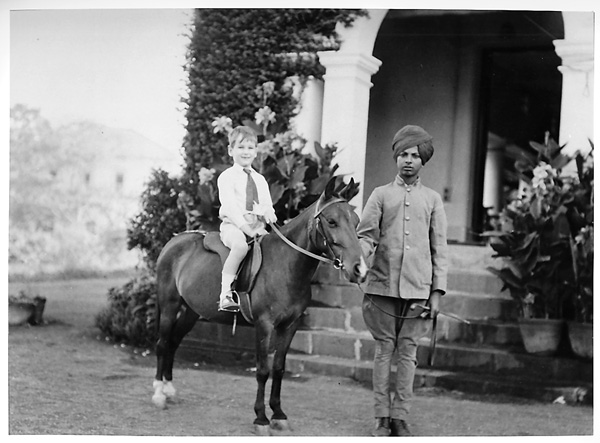 English child on pony held by servant; 20th century; photograph courtesy
of the Centre of South Asian Studies, University of Cambridge.
English child on pony held by servant; 20th century; photograph courtesy
of the Centre of South Asian Studies, University of Cambridge.
 Advertisement for cooling equipment in the Hoghunter's Annual (Calcutta)
for 1929.
Advertisement for cooling equipment in the Hoghunter's Annual (Calcutta)
for 1929.

 Behind the Bungalow by "EHA," illustrated by F.C. MacRae, 14th
edition (London: W. Thacker & Co; Calcutta and Simla: Thacker, Spink & Co.,
1929). Originally published in 1889 (reprinting earlier newspaper sketches),
this little volume went through numerous printings. Each chapter details
the activities of some type of servant and the book's popularity testifies
to the fascination their household servants held for the British (most
of whom could never have hoped to maintain such an establishment in England).
Behind the Bungalow by "EHA," illustrated by F.C. MacRae, 14th
edition (London: W. Thacker & Co; Calcutta and Simla: Thacker, Spink & Co.,
1929). Originally published in 1889 (reprinting earlier newspaper sketches),
this little volume went through numerous printings. Each chapter details
the activities of some type of servant and the book's popularity testifies
to the fascination their household servants held for the British (most
of whom could never have hoped to maintain such an establishment in England).


 Servant figurines; painted clay and lacquered fabric; late 19th
century; and servant figurine; painted clay; 20th century.
Such figurines were popular souvenirs available in great variety.
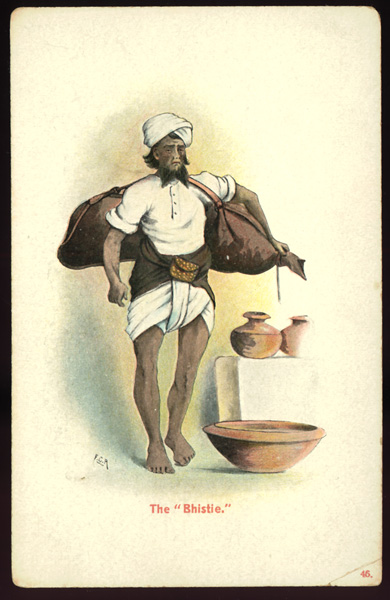
These represent a bearer or butler, a bhisti or water carrier, and a
sweeper.
Servant figurines; painted clay and lacquered fabric; late 19th
century; and servant figurine; painted clay; 20th century.
Such figurines were popular souvenirs available in great variety.
These represent a bearer or butler, a bhisti or water carrier, and a
sweeper.
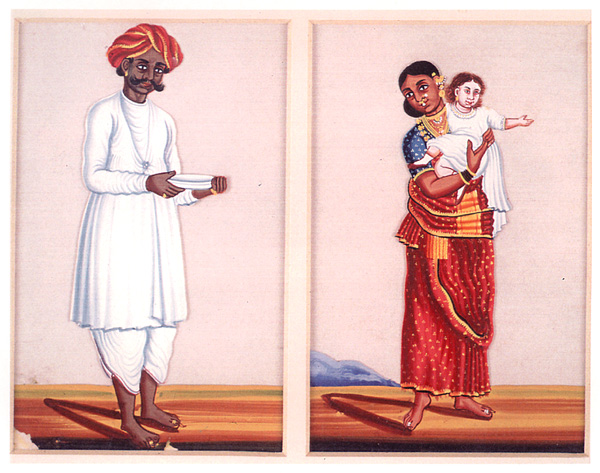
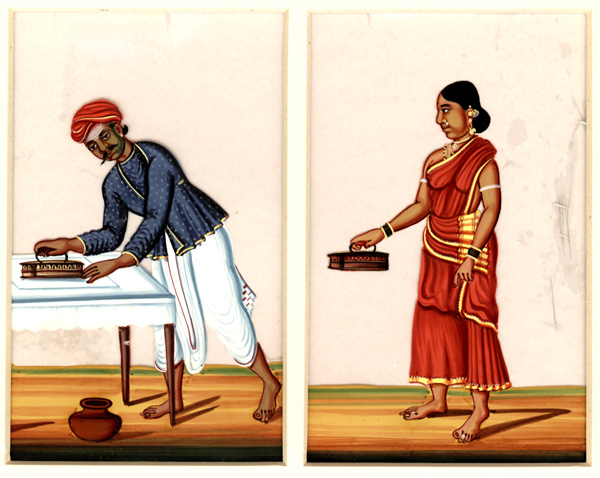 A bearer or head servant; an ayah holding a European child; a dhoby
or laundryman; the laundryman's wife. Company School paintings, South
India (Trichinopoly) on mica; c. 1860.
A bearer or head servant; an ayah holding a European child; a dhoby
or laundryman; the laundryman's wife. Company School paintings, South
India (Trichinopoly) on mica; c. 1860.
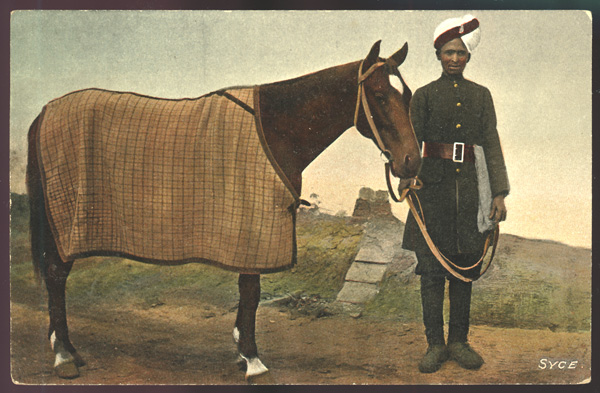
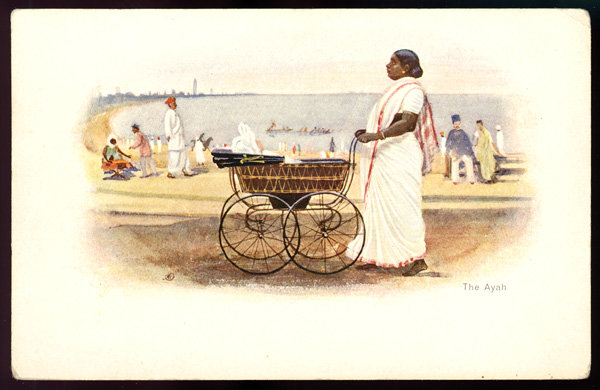

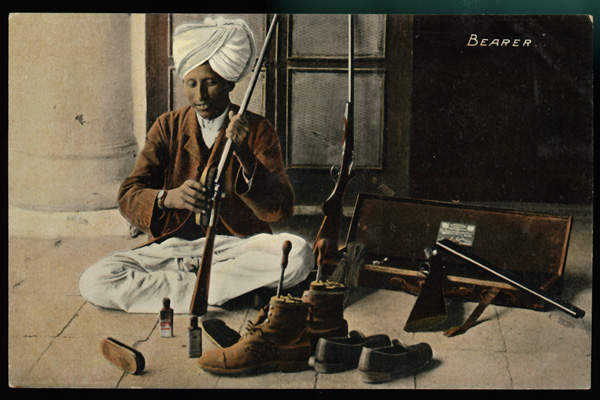

Postcards depicting household servants; produced by both Indian publishers, such as Moorli Dhur and Sons of Ambala, and British, such as Higginbotham and Company of Madras and Bangalore; early 20th century.
The great profusion of cards reflects the great profusion of servants: a syce to care for the horses which virtually every sahib maintained; the ayah to care for young children; the sweeper, who maintained latrines and removed "night soil"; the dhurzi, more of a subcontractor than a servant, who would come and sit in a European house for days at a time doing the sewing. The bearer was a man's personal servant who would run the household of a bachelor sahib.
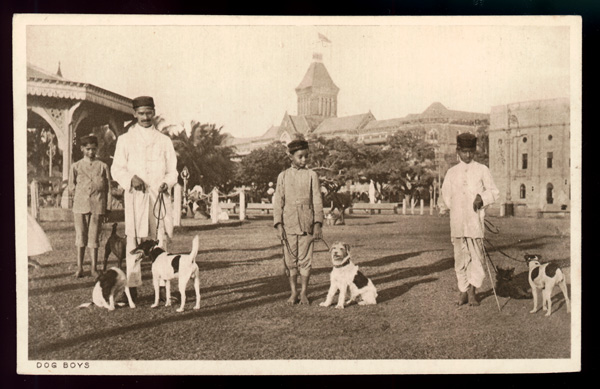



Sahibs and memsahinbs were especially intrigued by the dhobi or laundryman, who supposedly accorded unspeakably harsh treatment to their clothes to get them clean. Being able to employ an impressive number of servants -- far more than could have been afforded in England -- was an attraction of Anglo-Indian life (though many Britons professed their large households to be a mixed blessing).
 Englishman being shaved by servant; postcard (Madras and Bangalore:
Higginbotham and Company); early 20th century. Being shaved, even while still half asleep, epitomized for some the
luxury of Indian servants. Even working-class British soldiers stationed
in India would employ Indians to shave them while they still slept in their
barracks bunks. The chair depicted here is a planter's long-sleever, the
arms extended to provide a foot rest.
Englishman being shaved by servant; postcard (Madras and Bangalore:
Higginbotham and Company); early 20th century. Being shaved, even while still half asleep, epitomized for some the
luxury of Indian servants. Even working-class British soldiers stationed
in India would employ Indians to shave them while they still slept in their
barracks bunks. The chair depicted here is a planter's long-sleever, the
arms extended to provide a foot rest.


"Comic" postcards depicting the foibles of Indian servants--the lazy bearer who rests when his employer is away; the punkah-wallah who nods off when he is supposed to be awake pulling the rope that works the fan which cools his sleeping sahib (Madras and Bangalore: Higginbotham and Company); early 20th century.
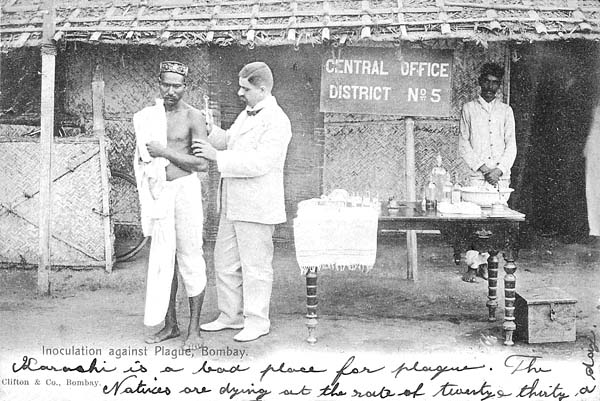
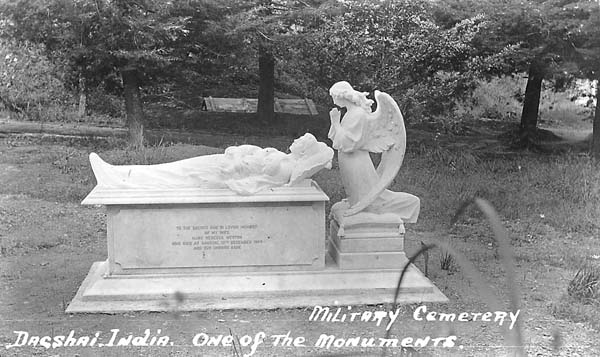 "Inoculation against the Plague, Bombay"; "Military Cemetery, Dagshai,
India"; postcards; early 20th century. From early days the British saw India as a place of danger and early
death, especially due to disease.
"Inoculation against the Plague, Bombay"; "Military Cemetery, Dagshai,
India"; postcards; early 20th century. From early days the British saw India as a place of danger and early
death, especially due to disease.
Life in the Bungalows
Recollections of English domestic life in India present a picture of an existence both contented and full of difficulties, both luxurious and spartan. Britons generally occupied commodious bungalows (the word itself comes from Indian terminology meaning something from Bengal and referred to a particular housetype originally from that province) and commonly employed numerous servants to run the household. Yet even into the 1940s the house would not have electricity, running water, refrigeration; it would have been open enough for insects, rats, snakes and--in remote areas--even wild animals to invade. Moves to new postings were frequent and thus life was unsettled. It was thought important to send children home to England for schooling, so that family members were separated. There were likely few other Europeans nearby, so that people--especially wives with no official work, possibly no children at home, and only a menage of servants to interact with all day--might feel very isolated. Indeed, women who found outside interests--whether their husbands' work, local charitable pursuits, or the outdoor life--were thought to be happiest.
"Dooreahs or Dog Keepers Leading Out Dogs"; aquatint by Samuel
Hewitt from a drawing by Captain Thomas Williamson; 1806.
An establishment which was an Indian version of an English country estate was an ideal striven for by earlier British sojourners in India, few of whom could have ever achieved anything so ambitious in England.
"Christmas in India"; chromoxylograph from a drawing by E.K. Johnson;
1881. An idealized picture of British home life: attentive servants and
happy children (who would be packed off to England for schooling before
long).
Bungalow occupied by a British family in Ranchi; 20th Century; photograph
courtesy of Major General R.C.A. Edge.
Tea plantation bungalow; 1930s.
Interior of tea plantation bungalow; 1930s. Though large and sometimes well furnished, British bungalows in India
might have very simple furnishings. Sometimes furniture was simply hired
from Indian contractors.
English child on pony held by servant; 20th century; photograph courtesy
of the Centre of South Asian Studies, University of Cambridge.
Advertisement for cooling equipment in the Hoghunter's Annual (Calcutta)
for 1929.
Behind the Bungalow by "EHA," illustrated by F.C. MacRae, 14th
edition (London: W. Thacker & Co; Calcutta and Simla: Thacker, Spink & Co.,
1929). Originally published in 1889 (reprinting earlier newspaper sketches),
this little volume went through numerous printings. Each chapter details
the activities of some type of servant and the book's popularity testifies
to the fascination their household servants held for the British (most
of whom could never have hoped to maintain such an establishment in England).
Servant figurines; painted clay and lacquered fabric; late 19th
century; and servant figurine; painted clay; 20th century.
Such figurines were popular souvenirs available in great variety.
These represent a bearer or butler, a bhisti or water carrier, and a
sweeper.
A bearer or head servant; an ayah holding a European child; a dhoby
or laundryman; the laundryman's wife. Company School paintings, South
India (Trichinopoly) on mica; c. 1860.
Postcards depicting household servants; produced by both Indian publishers, such as Moorli Dhur and Sons of Ambala, and British, such as Higginbotham and Company of Madras and Bangalore; early 20th century.
The great profusion of cards reflects the great profusion of servants: a syce to care for the horses which virtually every sahib maintained; the ayah to care for young children; the sweeper, who maintained latrines and removed "night soil"; the dhurzi, more of a subcontractor than a servant, who would come and sit in a European house for days at a time doing the sewing. The bearer was a man's personal servant who would run the household of a bachelor sahib.
Sahibs and memsahinbs were especially intrigued by the dhobi or laundryman, who supposedly accorded unspeakably harsh treatment to their clothes to get them clean. Being able to employ an impressive number of servants -- far more than could have been afforded in England -- was an attraction of Anglo-Indian life (though many Britons professed their large households to be a mixed blessing).
Englishman being shaved by servant; postcard (Madras and Bangalore:
Higginbotham and Company); early 20th century. Being shaved, even while still half asleep, epitomized for some the
luxury of Indian servants. Even working-class British soldiers stationed
in India would employ Indians to shave them while they still slept in their
barracks bunks. The chair depicted here is a planter's long-sleever, the
arms extended to provide a foot rest.
"Comic" postcards depicting the foibles of Indian servants--the lazy bearer who rests when his employer is away; the punkah-wallah who nods off when he is supposed to be awake pulling the rope that works the fan which cools his sleeping sahib (Madras and Bangalore: Higginbotham and Company); early 20th century.
"Inoculation against the Plague, Bombay"; "Military Cemetery, Dagshai,
India"; postcards; early 20th century. From early days the British saw India as a place of danger and early
death, especially due to disease.
Christmas In India during the British Raj
 Christmas
in India"; chromoxylograph from a drawing by E.K. Johnson; 1881. An
idealized picture of British home life: attentive servants and happy
children (who would be packed off to England for schooling before long).
Christmas
in India"; chromoxylograph from a drawing by E.K. Johnson; 1881. An
idealized picture of British home life: attentive servants and happy
children (who would be packed off to England for schooling before long). A bearer or valet and ayah or nursemaid
 A bhisti or water carrier
 Recollections
of English domestic life in India present a picture of an existence
both contented and full of difficulties, both luxurious and spartan.
Britons generally occupied commodious bungalows (the word itself comes
from Indian terminology meaning something from Bengal and referred to a
particular housetype originally from that province) and commonly
employed numerous servants to run the household.
Recollections
of English domestic life in India present a picture of an existence
both contented and full of difficulties, both luxurious and spartan.
Britons generally occupied commodious bungalows (the word itself comes
from Indian terminology meaning something from Bengal and referred to a
particular housetype originally from that province) and commonly
employed numerous servants to run the household.Yet even into the 1940s the house would not have electricity, running water, refrigeration; it would have been open enough for insects, rats, snakes and--in remote areas--even wild animals to invade. Moves to new postings were frequent and thus life was unsettled. It was thought important to send children home to England for schooling, so that family members were separated. There were likely few other Europeans nearby, so that people--especially wives with no official work, possibly no children at home, and only a menage of servants to interact with all day--might feel very isolated. Indeed, women who found outside interests--whether their husbands' work, local charitable pursuits, or the outdoor life--were thought to be happiest.

Vast exhibitions showcasing European overseas empires not only brought Indian architecture to England but played a major role in further building popular awareness of India.
=============================================================================
 Translate

The Passage to India

As the British presence in India grew, Britons increasingly went to India to run businesses and as administrators, soldiers, and missionaries. By the 19th century and into the 20th a life in India became a regular existence for many English men and women. Their personal motives were various: to make money, to find excitement, to improve their status, to maintain family tradition, and -- as a grand ideal of imperial service formed in Victorian times -- to serve their own nation and India itself. In many ways their personal motives are a microcosm of the reasons European nations and their societies sought imperial expansion.
Sometimes generations of the same family went to India. Some were born there, others recruited out of university or public school to join the police or the civil or the education or forest service. Whatever their backgrounds, those who went found themselves on a journey to a world very different from what they knew in the British Isles. Their literal passage on a steamship -- from cool England, through Gibraltar and across the increasingly foreign Mediterranean, through the Suez Canal (symbolic divider of West from East), into the sun-scorched Red Sea and steamy Indian Ocean to a land full of new sounds, sights, and smells -- was more than a mere trip but a rite of transition which often made a powerful impression.
Life in the Bungalows

Running Your Little Empire
The Indian Civil Service (or ICS) provided the men who governed India. Graduates of British universities who had passed an examination and interviews and then undertaken a year of training in England, most eventually worked as district officers, virtual rulers of the several hundred districts which were basic administrative units. Assisted by perhaps a few other Europeans as well as Indian officials and clerks, they might render legal decisions, determine land tenure, oversee local police, recommend public works projects, provide famine relief when necessary, even hunt leopards or tigers which menaced villagers. Their power and prestige were such that they were jokingly called "the heaven born" and likened to the Brahmans who stood at the top of the Indian caste system.
Other men assumed administrative positions in such organizations as the Forest Service, which cared for great jungle preserves; the Education Service, which ran schools; the Survey of India, which mapped the subcontinent; the state-owned railways; the Police; and the Political Service (made up of already-experienced officers from the ICS or the Army), which dealt with the Indian princes who ruled large portions of India under British oversight (they also staffed British consulates in parts of China and Persia and helped administer the sheikdoms of the Persian Gulf). Others joined commercial enterprises, such as the great trading houses of Calcutta and tea, coffee or jute plantations.
The military life also took many to India. India, in fact, had two large armies. The British Army posted a big part of its strength to India. But there was also the largely separate Indian Army, with British officers and Indian soldiers. Stationed in far-flung cantonments, Army officers worked in support of the civil administrators in maintaining control and engaged in the intermittent warfare which broke out in such areas as the Northwest Frontier, where potentially rebellious tribesmen kept the region unsettled.
Official India was virtually all male, but wives would often play major roles in their husbands' work, touring with them, ministering to local needs, and discovering local problems. Women might also lead more independent lives in mission work or in healing professions.
Imperial Diversions: The Club, the Hills, the Field
Never the Twain? Indo-British Relations
No More India to Go to: Departure and Connections
Most of the British in India returned home to retirement or new lives. Some "stayed on" in various capacities, but the old system which had sent Britons to India as colonial rulers had ended forever and with it a unique mode of life. Those who spoke of this end spoke of it with a mixture of regret, good will, recognition of the inevitable, and pleasure in on-going ties to the new nations.
Beyond personal ties, however, were the cultural ones which had grown up over the course of more than two centuries. India obtained the English language -- indeed, created a distinct version of English -- a factor which had a profound influence upon the writing and literature of the subcontinent. The English language, on the other hand, borrowed numerous words from Indian languages (pajama, jungle, coolie, bungalow, kabob). More importantly, the Indian connection gave English literature a milieu dissected and projected by numerous British writers -- Kipling, Forster, Paul Scott, George Orwell, Rumer Godden. British landscape artists -- Edward Lear, Sir Charles D'Oyly, William and Thomas Daniell -- were attracted to India to create vivid images that introduced Europeans to the physical shape -- both natural and cultural -- of the great subcontinent. The tradition of Indian miniature painting adapted itself to a British market. European style buildings sprouted all over India, while British architects adapted Indian styles for use both in India and Britain. British dominance brought about many changes in Indian life, while the Indian connection made a lasting impact upon British popular culture. Indeed, India became ingrained in British consciousness -- as an image, as a place where friends or family members lived, as a symbol of British power. Since the Second World War, there has been a mass influx of Indians and Pakistanis into Britain -- a development enabled by former imperial connections -- so that today, perhaps ironically, many more people from the subcontinent live in England than Britons ever lived in India. In many ways these Asians are now transforming British life.

The young Maharajah of Bastar with his British guardians; photograph courtesy of the Centre of South Asian Studies, University of Cambridge; 1937.
A significant portion of India continued to be ruled by Indian princes under indirect British control. When a minor ascended to a princely throne or if there was gross mismanagement or scandal in a princely state, a British official would be given more direct control. But normally a rajah or nawab had considerable independence to administer his own dominions under the influence of a British Resident or Political Agent.


Interviews with Sir Charles Dalton and his wife Lady Dalton:
Major-General Sir Charles Dalton:
Major-General Sir Charles Dalton:
Lady Daphne Dalton:
Lady Dalton:
Lady Daphne Dalton:
Lady Daphne Dalton:
Sir Charles Dalton:
Lady Dalton:
Sir Charles Dalton:
Lady Dalton:
Sir Charles Dalton:
Lady Dalton:
Sir Charles Dalton:
Sir Charles Dalton:
Lady Daphne Dalton:
Lady Daphne Dalton:
Major-General Sir Charles Dalton:
Sir Charles Dalton:
Lady Dalton:
Sir Charles Dalton:
Lady Daphne Dalton:
Sir Charles Dalton:
Lady Dalton:
Major-General Sir Charles Dalton:
Lady Daphne Dalton:
Major-General Sir Charles Dalton:
Lady Daphne Dalton:
OBITUARY For Major General Sir Charles Dalton
Newspaper articles about Major General Sir Charles Dalton:

British Dress Officer's Bengal Lancer Uniform, Indian, Circa ...
Days of the Raj: Huge collection of photographs showing life ...
Imperial Diversions:
The Club, the Hills, the Field
Britons who spoke of their pasts in India remembered the need for
diversions from what they saw as everyday lives of hard work and
often difficult conditions. Indeed these diversions--especially
the abundance of field sports--were seen as among the joys
of a life in India.
An Englishman in India could maintain horses whose upkeep in England
would have been prohibitively expensive. Thus he could have plenty of
recreational or competitive horseback riding. And the plenitude of
wild game provided the shooting beloved by the English upper classes, but
in India people could enjoy it without the need for private estates
or trout streams. In the hot season, when an intense sun baked the Indian plains, "the Hills" offered another kind of diversion, the relief of cool weather at high altitudes. From the early 19th century the British developed "hill stations," towns they could go up to when heat enveloped the rest of India. In fact, whole governments moved to the Hills in the hot months. Simla in the Himalayas became the official summer capital of British India when the Viceroy and much of the bureaucracy came up from Calcutta or New Delhi. With temporarily concentrated European populations, the hill stations were noted for gay, leisurely life, though working husbands customarily came for only short periods while their wives might spend the whole season.
Closer to home, the club offered a respite from daily routine. Virtually wherever in India a few Britons lived, a club evolved. It might have only a modest bar, a tennis court, perhaps a reading room, but it was an important institution as a central gathering place. The admission or exclusion of Indians as members or guests became a difficult issue in Indo-British relations as time went on.
 Paying off the beaters after a tiger hunt; 20th century; photograph
courtesy of the Centre of South Asian Studies, University of Cambridge.
Paying off the beaters after a tiger hunt; 20th century; photograph
courtesy of the Centre of South Asian Studies, University of Cambridge.
 Joining in field sports enabled English women to participate more fully
in the pleasures of life in India; photograph courtesy of Major General
R.C.A. Edge.
Joining in field sports enabled English women to participate more fully
in the pleasures of life in India; photograph courtesy of Major General
R.C.A. Edge.
 "A Little Over Ridden"; lithograph; 19th century.
Hog hunter, probably along the Ganges River.
The sport of hog hunting (or "pig sticking") involved chasing on
horseback and spearing dangerous wild hogs. Though limited geographically,
the sport had a very popular image, perhaps because it seemed to evoke
ancient ways and almost feudal methods of organization.
"A Little Over Ridden"; lithograph; 19th century.
Hog hunter, probably along the Ganges River.
The sport of hog hunting (or "pig sticking") involved chasing on
horseback and spearing dangerous wild hogs. Though limited geographically,
the sport had a very popular image, perhaps because it seemed to evoke
ancient ways and almost feudal methods of organization.
 "The Return from Hog Hunting"; aquatint by Samuel Hewett from a
drawing by Captain Thomas Williamson; 1819.
"The Return from Hog Hunting"; aquatint by Samuel Hewett from a
drawing by Captain Thomas Williamson; 1819.
 "The Line of Beaters," color illustration (from a water color by the author)
in Pig-Sticking or Hog-Hunting: A Complete Account for Sportsmen--and
Others by Sir Robert Baden-Powell, Bart. (London: Herbert Jenkins, 1924).
"The Line of Beaters," color illustration (from a water color by the author)
in Pig-Sticking or Hog-Hunting: A Complete Account for Sportsmen--and
Others by Sir Robert Baden-Powell, Bart. (London: Herbert Jenkins, 1924).
The founder of the Boy Scouts, who had seen Army service in India, was a notable devotee of the sport.
 British soldiers on the Mall at Murree, a popular hill station; postcard; 1920s.
 "Simla--the Mall"; postcard, photograph by R. Hotz; c. 1900. Simla, where the Government of India functioned during the hot
weather, was a vibrant temporary capital. The architecture seen here is
notably European, as though the Hills were meant to be psychologically
as well as physically removed from the terrible heat and
related pressures of the Indian plains.
"Simla--the Mall"; postcard, photograph by R. Hotz; c. 1900. Simla, where the Government of India functioned during the hot
weather, was a vibrant temporary capital. The architecture seen here is
notably European, as though the Hills were meant to be psychologically
as well as physically removed from the terrible heat and
related pressures of the Indian plains.
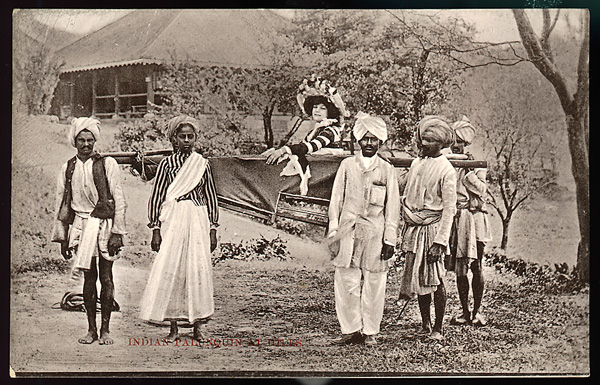
 Women in dandi, sedan chairs used to carry European travellers
through the Hills; postcards (Umballa: Herman Dass and Sons); 1890s.
Women in dandi, sedan chairs used to carry European travellers
through the Hills; postcards (Umballa: Herman Dass and Sons); 1890s.

"Simla"; lithograph by Captain J. Luard; 19th century. Only the workers in Indian garb suggest that this is not a European landscape, as though the Hills were not merely a refuge from the heat but a kind of symbolic return to a more culturally familiar place.
 Club scene; color illustrations in Lloyd's
Sketches of Indian Life by W. Lloyd (London: Chapman and Hall, 1890).
Club scene; color illustrations in Lloyd's
Sketches of Indian Life by W. Lloyd (London: Chapman and Hall, 1890).

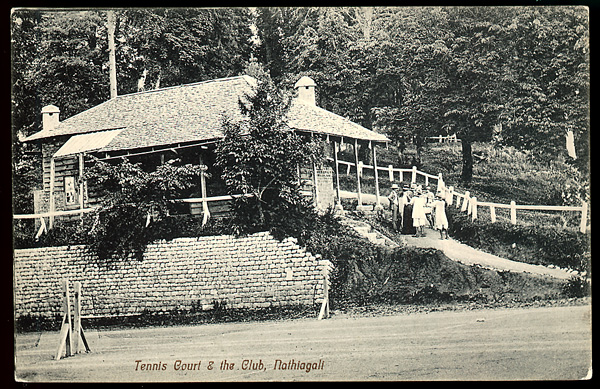 Two clubs: British Indian clubs might be as grand as the "Royal
Bombay Yacht Club" or as simple as that in a smaller station,
such as "Tennis Court & the Club, Nathiagali"; postcards;
early 20th century. On the reverse of the Bombay Yacht card a correspodent has
written:
"A lovely club. People have tea parties on the lawn (behind the wall)."
Two clubs: British Indian clubs might be as grand as the "Royal
Bombay Yacht Club" or as simple as that in a smaller station,
such as "Tennis Court & the Club, Nathiagali"; postcards;
early 20th century. On the reverse of the Bombay Yacht card a correspodent has
written:
"A lovely club. People have tea parties on the lawn (behind the wall)."Never the Twain? Indo-British Relations
The nature of relations between the British and Indians changed over time, as did British attitudes toward India and Indians. In earlier days some Britons assimilated readily to Oriental ways of life or even intermarried with Indians. Particularly after the traumatic uprising of 1857-58, however, relations were often strained, as conventional ideas about European racial superiority became more prominent and as Victorian notions of morality and evangelical movements to convert the world to a particular kind of Christianity became influential. By the latter part of the 19th century, for example, the idea of a "respectable" English person marrying an Indian was virtually unthinkable. Of course, the very fact that the British were by definition a ruling elite and Indians -- however rich or important -- a subject people often strained relations. This could exacerbate cultural misunderstandings, a situation which is the focus of E.M. Forster's great anti-imperial novel, A Passage to India.Those who remembered their time in India were aware that the Indo-British relationship was often problematic. They felt, for example, that a certain need to be impartial outsiders in the administration of Indian matters sometimes made them seem aloof. Yet they insisted that they frequently had cordial relations with Indians and were in close contact with many aspects of Indian life and society. They spoke Indian languages and, if touring a district, might interact with no one but Indians for weeks or months at a time. As time went on there was also increasing emphasis on Indianization of the various British services, so that more Indians came to have responsible positions that made them officially equal or even superior to Englishmen in the administrative systems.
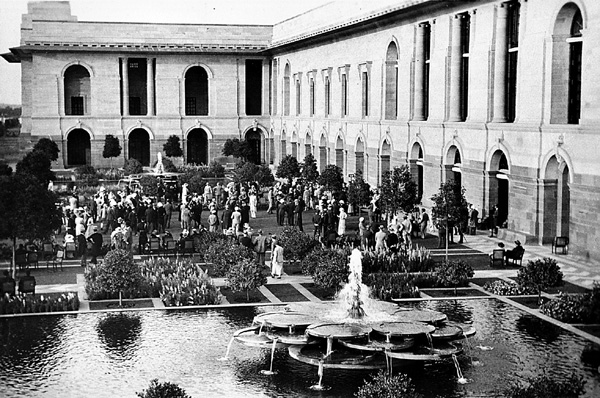 Garden party with British and
Indian guests at the Viceroy's Palace, New Delhi; photograph courtesy
of Brigadier Richard Gardiner; 1930s.
Garden party with British and
Indian guests at the Viceroy's Palace, New Delhi; photograph courtesy
of Brigadier Richard Gardiner; 1930s.
 Indian man with Englishwomen at a fete to aid the Indian Red Cross;
photograph courtesy of Major General Sir Charles and Lady Dalton; 1930s.
Indian man with Englishwomen at a fete to aid the Indian Red Cross;
photograph courtesy of Major General Sir Charles and Lady Dalton; 1930s.
Constraints in social relations sometimes meant that Britons interacted with Indians mostly in formal or superficial situations.
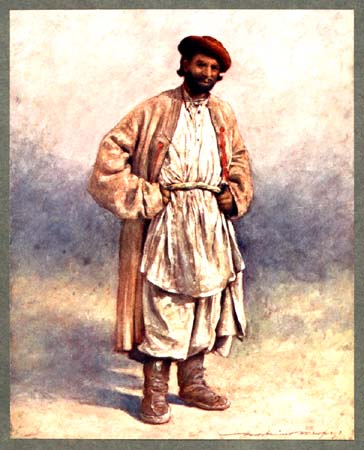 "A Hindu Hill Shepherd of Kashmir," color illustration (from a
watercolor original) by Mortimer Menpe7s in his The People of India
(London: Adam and Charles Black, 1910).
"A Hindu Hill Shepherd of Kashmir," color illustration (from a
watercolor original) by Mortimer Menpe7s in his The People of India
(London: Adam and Charles Black, 1910).
In their taped recollections Britons spoke with particular affection of encounters with Indian peasants and other common folk. Of course there was no question of peasants claiming social equality with European sahibs, so they in no way impinged on British dominance and could even be romanticized.
On the other hand, interviewees suggested they had limited intercourse with educated, middle class Indians -- who increasingly challenged British rule as time went on -- and some indicated ambivalence about or suspicion toward such people.
 British and Indian guests
of a maharajah, dining in a tent; photograph courtesy of the Centre of
South Asian Studies, University of Cambridge; early 20th century.
British and Indian guests
of a maharajah, dining in a tent; photograph courtesy of the Centre of
South Asian Studies, University of Cambridge; early 20th century.
Socializing with Indian princes was a high point of life in India according to many recollections. Connections to this world of royalty could validate British status.
 "The Folly of Worshipping Cobras Cut in Stone," photographic
illustration in Across India at the Dawn of the 20th Century, by Lucy E.
Guinness (London: Religious Tract Society, 1898).
"The Folly of Worshipping Cobras Cut in Stone," photographic
illustration in Across India at the Dawn of the 20th Century, by Lucy E.
Guinness (London: Religious Tract Society, 1898).
British attitudes toward Indian culture were complex. A few English people became devoted students of it, some had little interest in or were even appalled by it, others took a selective interest. Guinness's travel account was meant to champion the work of Christian missionaries and thus to denigrate Indian "paganism". However, in general interest in Indian customs sometimes focussed on those which were disquieting to Europeans. There was considerable fascination with the practice of "suttee," the immolation of widows on the funeral pyres of their husbands, a practice finally outlawed.
And there were many accounts of the Jaganath procession, in which the Hindu deity was pulled on a cart by devotees, some of whom were crushed beneath it in an excess of religious fervor. Such customs could serve to suggest fanaticism, social instability, and the continuing need for British rule to control such excesses.
 "Sutteeism on the Banks of the Ganges --
Preparing for the Immolation of a
Hindoo Widow," steel engraving by J. Hedway from a drawing by Captain
Grindlay in The Indian Empire: Its History, Topography, Government,
Finance, Commerce, and Staple Products, by R. Montgomery Martin, 5 vols.
(London: London Printing and Publishing Co., 1879-81?).
"Sutteeism on the Banks of the Ganges --
Preparing for the Immolation of a
Hindoo Widow," steel engraving by J. Hedway from a drawing by Captain
Grindlay in The Indian Empire: Its History, Topography, Government,
Finance, Commerce, and Staple Products, by R. Montgomery Martin, 5 vols.
(London: London Printing and Publishing Co., 1879-81?).


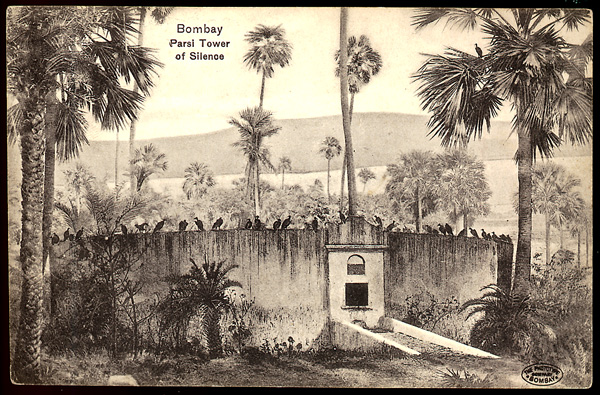
"The Burning Ghat -- Calcutta"; postcard (Calcutta: Art Union), early 20th century; "The Burning Ghat, Benares"; postcard (London: Raphael Tuck and Sons), 20th century; "Bombay Parsi Tower of Silence"; postcard (Bombay: Phototype Co.), early 20th century.
"Exotic," and to Europeans perhaps horrifying, Indian modes of disposing of the dead -- such as the Hindu practice of public immolation and the Parsi custom of exposing the bodies to be eaten by birds -- intrigued the British.
 "Devotees in India Sacrificing Themselves to the Idol Juggernaut";
wood engraving; 19th century.
"Devotees in India Sacrificing Themselves to the Idol Juggernaut";
wood engraving; 19th century.
================================================================================================================================================
Images of British India
:max_bytes(150000):strip_icc():format(webp)/Madras-Army-gty-56a486ef3df78cf77282d99c.jpg)
Map of Hindostan, or British India
:max_bytes(150000):strip_icc():format(webp)/Hindoostan-map-gty-56a486ec5f9b58b7d0d76bdf.jpg)
Vintage Images of The Raj
The British Empire's jewel was India, and images of The Raj, as British India was known, fascinated the public at home.
This gallery provides a sample of 19th century prints showing how British India was depicted.
An 1862 map depicted British India at its peak.
The British first arrived in India in the early 1600s as traders, in the form of the East India Company. For more than 200 years the company engaged in diplomacy, intrigue, and warfare. In exchange for British goods, the riches of India flowed back to England.
Over time, the British conquered most of India. The British military presence was never overwhelming, but the British employed native armies.
In 1857-58 an astonishingly violent revolt against British rule took months to subdue. And by the early 1860s, when this map was published, the British government had dissolved the East India Company and had taken direct control of India.
In the upper right corner of this map is an illustration of the elaborate Government House and Treasury complex in Calcutta, a symbol of the British administration of India.
Native Soldiers
When the East India Company ruled India, they did so largely with native soldiers.
Native soldiers, known as Sepoys, provided much of the manpower that allowed the East India Company to rule India.
This illustration depicts members of the Madras Army, which was composed of native Indian troops. A highly professional military force, it was used to subdue rebel uprisings in the early 1800s.
The uniforms used by native troops working for the British were a colorful blend of traditional European military uniforms and Indian items, such as elaborate turbans.
The Nabob of Cambay
:max_bytes(150000):strip_icc():format(webp)/Nabob-of-Cambay-gty-56a486f13df78cf77282d99f.jpg)
A local ruler was depicted by a British artist.
This lithograph depicts an Indian leader: "nabob" was the English pronunciation of the word "nawab," a Muslim ruler of an area in India. Cambay was a city in northwest India now known as Kambhat.
This illustration appeared in 1813 in the book Oriental Memoirs: A Narrative of Seventeen Years Residence in India by James Forbes, a British artist who had served in India as an employee of the East India Company.
The plate with this portrait was captioned:
Mohman Khaun, Nabob of Cambay
The drawing from which this is engraved was made at a public interview between the Nabob and the Mahratta sovereign, near the walls of Cambay; it was thought to be a strong likeness, and an exact representation of the Mogul costume. On that particular occasion the Nabob wore no jewels, nor any kind of ornament, except a fresh-gathered rose on one side of his turban.
The word nabob made its way into the English language. Men who had made fortunes in the East India Company were known to return to England and flaunt their wealth. They were laughingly referred to as nabobs.
Musicians With Dancing Snake
:max_bytes(150000):strip_icc():format(webp)/Dancing-Snake-gty-56a486e93df78cf77282d990.jpg)
The British public was fascinated by images of exotic India.
In a time before photographs or films, prints such as this depiction of Indian musicians with a dancing snake would have been fascinating to an audience back in Britain.
This print appeared in a book titled Oriental Memoirs by James Forbes, a British artist and writer who traveled extensively in India while working for the East India Company.
In the book, which was published in several volumes beginning in 1813, this illustration was described:
Snakes and Musicians:
Engraved from a drawing taken on the spot by Baron de Montalembert, when aid-de-camp to General Sir John Craddock in India. It is in all respects an exact representation of the Cobra de Capello, or Hooded Snake, with the musicians who accompany them throughout Hindostan; and exhibits a faithful picture of the costume of the natives, usually assembled in the bazaars on such occasions.
Smoking a Hookah
:max_bytes(150000):strip_icc():format(webp)/India-Hookah-gty-56a486ed3df78cf77282d996.jpg)
The English in India adopted some Indian customs, such as smoking a hookah.
A culture developed in India of employees of the East India Company adopting some local customs while remaining distinctly British.
An Englishman smoking a hookah in the presence of his Indian servant seems to present a microcosm of British India.
The illustration was originally published in a book, The European In India by Charles Doyley, which was published in 1813.
Doyley captioned the print thusly: "A Gentleman With His Hookah-Burdar, or Pipe-Bearer."
In a paragraph describing the custom, Doyley said many Europeans in India are "absolutely slaves to their Hookahs; which, excepting while sleeping, or in the early parts of meals, are ever at hand."
An Indian Woman Dancing
:max_bytes(150000):strip_icc():format(webp)/India-Dancing-gty-56a486ec3df78cf77282d993.jpg)
The traditional dancing of India was a source of fascination for the British.
This print appeared in a book published in 1813, The European In India by the artist Charles Doyley. It was captioned: "A Dancing Woman of Lueknow, Exhibiting Before a European Family."
Doyley went on at considerable length about the dancing girls of India. He mentioned one who could, "by the grace of her motions... hold in complete subjection... many scores of fine young British officers."
Indian Tent at Great Exhibition
:max_bytes(150000):strip_icc():format(webp)/Indian-tent-Great-Exhibition-gty-56a486ee3df78cf77282d999.jpg)
The Great Exhibition of 1851 featured a hall of items from India, including an opulent tent.
In the summer of 1851 the British public was treated to an amazing spectacle, the Great Exhibition of 1851. Primarily a colossal technology show, the exhibition, held in the Crystal Palace in Hyde Park, in London, featured exhibits from around the world.
Prominent in the Crystal Palace was an exhibit hall of items from India, including a stuffed elephant. This lithograph shows the interior of an Indian tent which was shown at the Great Exhibition.
Storming the Batteries
:max_bytes(150000):strip_icc():format(webp)/Storming-Batteries-gty-56a486f15f9b58b7d0d76be2.jpg)
The 1857 uprising against British rule led to scenes of intense combat.
In the spring of 1857 a number of units of the Bengal Army, one of three native armies in the employ of the East India Company, rebelled against British rule.
The reasons were complex, but one event that set things off was the introduction of a new rifle cartridge rumored to contain grease derived from pigs and cows. Such animal products were forbidden to Muslims and Hindus.
While the rifle cartridges may have been the final straw, relations between the East India Company and the native population had been degenerating for some time. And when the rebellion broke out, it became extremely violent.
This illustration depicts a charge a British Army unit made against gun batteries manned by mutinous India troops.
An Outlying Picket Post
:max_bytes(150000):strip_icc():format(webp)/British-Picket-Post-gty-56a486e85f9b58b7d0d76bd9.jpg)
The British were greatly outnumbered during the 1857 uprising in India.
When the uprising began in India, the British military forces were badly outnumbered. They often found themselves besieged or surrounded, and pickets, such as those depicted here, were often watching for attacks by Indian forces.
British Troops Hasten to Umballa
:max_bytes(150000):strip_icc():format(webp)/Hasten-to-Umballa-gty-56a486ea5f9b58b7d0d76bdc.jpg)
The outnumbered British forces had to move quickly to react to the 1857 uprising.
When the Bengal Army rose up against the British in 1857 the British military was dangerously overstretched. Some British troops were surrounded and massacred. Other units raced from remote outposts to join the fight.
This print depicts a British relief column which traveled by elephant, ox cart, horse, or on foot.
British Troops in Delhi
:max_bytes(150000):strip_icc():format(webp)/British-Troops-Delhi-56a486e93df78cf77282d98d.jpg)
British forces succeeded in retaking the city of Delhi.
The siege of the city of Delhi was a major turning point of the 1857 uprising against the British. Indian forces had taken the city in the summer of 1857 and set up strong defenses.
British troops besieged the city, and eventually in September they retook it. This scene depicts revelry in the streets following the heavy fighting.
Queen Victoria and Indian Servants
:max_bytes(150000):strip_icc():format(webp)/Victoria-garden-servants-gty-56a486f25f9b58b7d0d76be5.jpg)
Britain's monarch, Queen Victoria, was fascinated by India and retained Indian servants.
Following the uprising of 1857-58, Britain's monarch, Queen Victoria, dissolved the East India Company and the British government took over control of India.
The queen, who was keenly interested in India, eventually added the title "Empress of India" to her royal title.
Queen Victoria also became very attached to Indian servants, such as those pictured here at a reception with the queen and members of her family.
Throughout the last half of the 19th century the British Empire, and Queen Victoria, held a firm grip on India. In the 20th century, of course, resistance to British rule would increase, and India would eventually become an independent nation.
Related Articles
:max_bytes(150000):strip_icc():focal(1499x0:1501x2):format(webp)/Taj-Mahal-3000x2100gty-58b96fbd3df78c353cdb7d14.jpg)
:max_bytes(150000):strip_icc():focal(1892x0:1894x2):format(webp)/indian-uprising-108021902-8b6ddc0d00d84612bd59c0361a8d2995.jpg)
:max_bytes(150000):strip_icc():focal(1089x0:1091x2):format(webp)/Remnants_of_an_army2-5c380bdd46e0fb000100a8b9.jpg)
:max_bytes(150000):strip_icc():focal(1028x0:1030x2):format(webp)/GettyImages-153413308-9449701eddd14ff7af88fb56f0ef445e.jpg)
:max_bytes(150000):strip_icc():focal(149x0:151x2):format(webp)/commerce-thoughtco-5a8c90ffc5542e0037f20f59.png)
:max_bytes(150000):strip_icc():focal(314x0:316x2):format(webp)/naponil_05-56a039383df78cafdaa08f1b.JPG)
:max_bytes(150000):strip_icc():focal(1057x0:1059x2):format(webp)/GettyImages-92030712-5c61ba3f46e0fb000184a25b.jpg)
:max_bytes(150000):strip_icc():focal(1801x0:1803x2):format(webp)/GettyImages-613464640-5c867e5fc9e77c0001422f84.jpg)
:max_bytes(150000):strip_icc():focal(1209x0:1211x2):format(webp)/Queen-Victoria-1861-3069809x-56aa25ec3df78cf772ac8b4b.jpg)
:max_bytes(150000):strip_icc():focal(1347x0:1349x2):format(webp)/Benjamin-Disraeli-2697-3x2-56a4894d3df78cf77282de07.jpg)
:max_bytes(150000):strip_icc():focal(1138x0:1140x2):format(webp)/GettyImages-154888702-589e88653df78c47585856cc.jpg)
:max_bytes(150000):strip_icc():focal(566x0:568x2):format(webp)/Wellington_at_Waterloo_Hillingford-4340c30ca22245a7b6a6a4fcf622100a.jpg)
:max_bytes(150000):strip_icc():focal(2590x0:2592x2):format(webp)/GettyImages-3311197-59f09657d088c00010d8c2bf.jpg)
:max_bytes(150000):strip_icc():focal(1002x0:1004x2):format(webp)/GettyImages-3280295-c111dde3477b4826910a832ddc90308e.jpg)
Biography of Mary of Teck, Royal British Matriarch
:max_bytes(150000):strip_icc():focal(1101x0:1103x2):format(webp)/The_East_offering_its_riches_to_Britannia_-_Roma_Spiridone_1778_-_BL_Foster_245-595dd0485f9b58843f032c8d.jpg)
:max_bytes(150000):strip_icc():focal(1111x0:1113x2):format(webp)/edwardvii-5b7afbd946e0fb0082e64dc0.png)
Biography of Edward VII, Britain's Peaceful Playboy King
.......................................................................................................................................................
%3Amax_bytes(150000)%3Astrip_icc()%2FMadras-Army-gty-56a486ef3df78cf77282d99c.jpg&imgrefurl=https%3A%2F%2Fwww.thoughtco.com%2Fimages-of-british-india-4122914&docid=VFZaVg-2YbphDM&tbnid=jVs-7lr1v-xXrM&vet=12ahUKEwiPs8WcjYKWAxVWka8BHRdPOtwQnPAOegQIPRAA..i&w=1500&h=1029&hcb=2&ved=2ahUKEwiPs8WcjYKWAxVWka8BHRdPOtwQnPAOegQIPRAA)


.png)
%3Amax_bytes(150000)%3Astrip_icc()%2FHindoostan-map-gty-56a486ec5f9b58b7d0d76bdf.jpg&imgrefurl=https%3A%2F%2Fwww.thoughtco.com%2Fimages-of-british-india-4122914&docid=VFZaVg-2YbphDM&tbnid=uzKEXJFKr3cAUM&vet=12ahUKEwiPs8WcjYKWAxVWka8BHRdPOtwQnPAOegQIfhAA..i&w=1500&h=1129&hcb=2&ved=2ahUKEwiPs8WcjYKWAxVWka8BHRdPOtwQnPAOegQIfhAA)


.png)


%2B(24).jpg&imgrefurl=https%3A%2F%2Fwww.oldindianphotos.in%2F2010%2F03%2Fvarious-british-raj-photos-1904-1906.html&docid=f18UNngGdndkGM&tbnid=sD6lpiv5lROqcM&vet=12ahUKEwiPs8WcjYKWAxVWka8BHRdPOtwQnPAOegUI_QIQAA..i&w=500&h=666&hcb=2&ved=2ahUKEwiPs8WcjYKWAxVWka8BHRdPOtwQnPAOegUI_QIQAA)


![Rare 100-Year-Old Photos of India from the British Raj Era Discovered [PHOTOS] | IBTimes UK](https://www.google.com/imgres?q=%0D%0AImages%20of%20British%20India&imgurl=https%3A%2F%2Fd.ibtimes.co.uk%2Fen%2Ffull%2F271573%2Frare-100-year-old-photos-india-british-raj-era.jpg%3Fw%3D1600%26h%3D1600%26l%3D51%26t%3D39%26q%3D88%26f%3D5ad4585d92e549e020f078b3a001f4e5&imgrefurl=https%3A%2F%2Fwww.ibtimes.co.uk%2Frare-100-year-old-photos-india-british-338333&docid=P-6OHsPdX30sUM&tbnid=QKTB6EpZfZO3hM&vet=12ahUKEwjdv5zxmIKWAxV2XGwGHR_wBFI4ChCc8A56BQiWAxAA..i&w=1600&h=1600&hcb=2&ved=2ahUKEwjdv5zxmIKWAxV2XGwGHR_wBFI4ChCc8A56BQiWAxAA)


![Provinces of British India, 1874 [OC] [2353x2803] : r/MapPorn](https://www.google.com/imgres?q=%0D%0AImages%20of%20British%20India&imgurl=https%3A%2F%2Fexternal-preview.redd.it%2Fprovinces-of-british-india-1874-2353x2803-v0-4STAviTQavGoM-xC8aSVY6OLPTfjnMHtPSpxo6Wj9gk.png%3Fwidth%3D640%26crop%3Dsmart%26auto%3Dwebp%26s%3Debe715164f8c393bedb6b3b76da0eb7c28b1ffcb&imgrefurl=https%3A%2F%2Fwww.reddit.com%2Fr%2FMapPorn%2Fcomments%2F81y22w%2Fprovinces_of_british_india_1874_oc_2353x2803%2F&docid=T-4DU4VpYX6pqM&tbnid=26i8puMgUM3V4M&vet=12ahUKEwjdv5zxmIKWAxV2XGwGHR_wBFI4ChCc8A56BQj8ARAA..i&w=640&h=762&hcb=2&ved=2ahUKEwjdv5zxmIKWAxV2XGwGHR_wBFI4ChCc8A56BQj8ARAA)


No comments:
Post a Comment