
King and I
 File:Madhu Rao Narayan the Maratha Peshwa with Nana Fadnavis and attendants Poona 1792 by James Wales.jpg
King and I
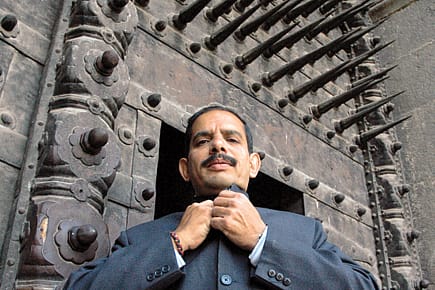
Mahendra Peshwa, descendant of the legendary Maratha rulers, is like any other guy
I may be a Peshwa descendant, but does it really mean anything in 2009? When a traffic policeman stops me today and checks my driving licence, he does not even raise an eyebrow. The name Peshwa means nothing to him. He couldn't care less. And this, in Pune, a city from where my forefathers ruled large parts of India for nearly a hundred years.
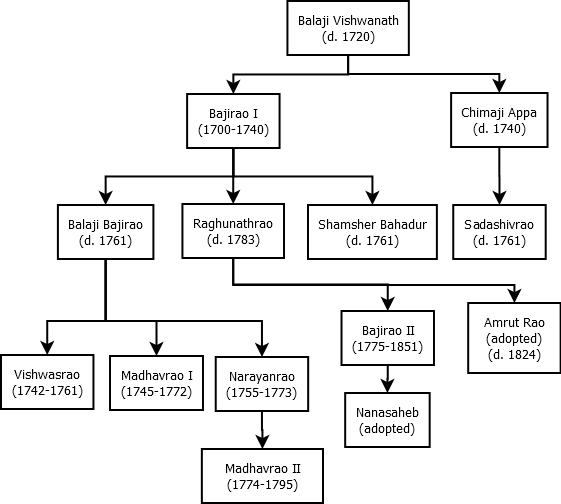
Why just the policeman. I am a non-entity even at the Parvati hill temple, which houses the family's Lord Shiva deity. I am not allowed to enter the sanctum to perform a puja, despite the temple being run by the Dev Deveshwar Sansthan trust started by Nanasaheb Peshwa, my forefather in 1749. Today, none of my family members is on the five-man committee and this prevents us from performing even a puja.
We have filed a case with the Charity Commissioner in Pune in 2001 demanding permanent places for at least two Peshwas on the committee, given the history of the trust. However, as is typical in India, no decision has been forthcoming from the commissioner for eight long years.
It is a well-documented fact that as the Peshwas battled the British tooth and nail, the British confiscated and destroyed all the Peshwa property in Pune, except the Parvati hill temple run by the Dev Deveshwar Sansthan.
Presently, the only property that our family owns is in far away Varanasi, where we have two small ghats and two temples, one dedicated to Lord Shiva and the other to Lord Ganesha. These temples and ghats were built by another of my forefathers, Amrutrao Peshwa, brother of Bajirao Peshwa II in 1807. I go on an annual pilgrimage to Varanasi every winter. It is the best time of the year to visit, as the weather is cool.


Rashtrakuta, Pala, Gurjara Pratihara empires controlled parts of India. And then Delhi Sultanate, Kakatiya,
Chalukya... later Vijayanagara.
The Maratha empire


Maratha Empire
| Maratha Empire | |||||
| मराठा साम्राज्य Marāṭhā Sāmrājya | |||||
| |||||
 Flag | |||||
 Territory under Maratha control in 1760 (yellow), without its vassals. | |||||
| Capital | Raigad | ||||
| Languages | Marathi, Sanskrit[1] | ||||
| Religion | Hinduism | ||||
| Government | Monarchy | ||||
| Chattrapathi | |||||
| - | 1674–1680 | Shivaji (first) | |||
| - | 1808–1818 | Pratapsingh (last) | |||
| Peshwa | |||||
| - | 1674–1689 | Moropant Pingle (first) | |||
| - | 1795–1818 | Baji Rao II (last) | |||
| Legislature | Ashta Pradhan | ||||
| History | |||||
| - | Deccan Wars | 1674 | |||
| - | Anglo-Maratha War | 1818 | |||
| Area | |||||
| 2,800,000 km² (1,081,086 sq mi) | |||||
| Population | |||||
| - | 1700 est. | 150,000,000 | |||
| Currency | Rupee, Paisa, Mohor, Shivrai, Hon | ||||
| Today part of |  India India Pakistan Pakistan Bangladesh Bangladesh | ||||


| Outline of South Asian history History of Indian subcontinent |
|---|
The Marathas were a yeoman Hindu warrior group from the western Deccan (present day Maharashtra) that rose to prominence by establishing 'Hindavi Swarajya'. According to the Encyclopædia Britannica, "The Maratha group of castes is a largely rural class of peasant cultivators, landowners, and soldiers. Some Maratha and Kunbi have at times claimed Kshatriya (the warrior and ruling class) standing and supported their claims to this rank by reference to clan names and genealogies linking themselves with epic heroes, Rajput clans of the north, or historical dynasties of the early medieval period."[3] The Marathas became prominent in the 17th century under the leadership of Shivaji who revolted against the Bijapur Sultanate and the Mughal Empire, and carved out a rebel territory with Raigad as his stronghold.[4] Known for their mobility, the Marathas were able to consolidate their territory during the Deccan Wars against the Mughal emperor Aurangzeb and, later in time, controlled a large part of India.[3] The word Maratha has been used to describe all the Marathi speaking inhabitants of Maharashtra. Shivaji's lieutenants in addition to the "Maratha" included those belonging to the CKP ( Baji Prabhu Deshpande and Murar Baji)[5] and Deshastha Brahmin castes.[6] The expansion of the empire under Shahu was carried by the generals belonging to groups such as Chitpavan Brahmin (Bhat Peshwas of Pune),[7] the Kunbis (Shinde of Gwalior) and Dhangar (Holkar of Indore).[8][9]
Shahu, a grandson of Shivaji, was released by the Mughals after the death of Aurangzeb. Following a brief struggle with his aunt Tarabai, Shahu became ruler. During this period, he appointed Balaji Vishwanath Bhat and later his descendants as the Peshwas or the prime ministers of the Maratha Empire. After the death of the Mughal Emperor Aurangzeb, the empire expanded greatly under the rule of the Peshwas. The empire at its peak stretched from Tamil Nadu[10][11] in the south, to Peshawar(modern-day Khyber Pakhtunkhwa) in the north, and Bengal and Andaman Islands in the east.[12][13] In 1761, the Maratha army lost the Third Battle of Panipat to Ahmed Shah Abdali of the Afghan Durrani Empire which halted their imperial expansion in North western India. Ten years after Panipat, young Madhavrao Peshwa reinstated the Maratha authority over North India.
In a bid to effectively manage the large empire, he gave semi-autonomy to the strongest of the knights, which created a confederacy of Maratha states. They became known as Gaekwads of Baroda, the Holkars of Indore and Malwa, the Scindias of Gwalior and Ujjain, Bhonsales of Nagpur. In 1775, the British East India Company intervened in a succession struggle in Pune, which became the First Anglo-Maratha War. The Marathas remained the preeminent power in India until their defeat in the Second and Third Anglo-Maratha wars (1805–1818), which left the British East India Company in control of most of India.
A large portion of the Maratha empire was coastline, which had been secured by a potent navy under commanders such as Kānhōjī Āngré. He was very successful at keeping foreign naval ships, particularly of the Portuguese and British, at bay.[14] Securing the coastal areas and building land-based fortifications were crucial aspects of the Maratha's defensive strategy and regional military history.
Contents
- 1 Nomenclature
- 2 Brief history
- 3 The Royal Era (1674–1749)
- 4 The Peshwa era (1749 to 1761)
- 5 The Confederacy era (1761–1818)
- 6 Administration
- 7 Geography
- 8 Legacy
- 9 Maratha Notable Generals and Administrators
- 10 Personalities
- 11 Chieftains
- 12 Maps showing the Maratha Empire at different stages of history
- 13 Thanjavur Maratha Kingdom (Tamil Nadu)
- 14 Gallery
- 15 See also
- 16 Notes
- 17 References
Nomenclature
The Maratha Empire is also referred to as the Maratha Confederacy. The historian Barbara Ramusack says that the former is a designation preferred by Indian nationalists, while the latter was that used by British historians. She notesNeither term is fully accurate since one implies a substantial degree of centralisation and the other signifies some surrender of power to a central government and a longstanding core of political administrators.[8]
Brief history
After a lifetime of guerrilla warfare with the Adil Shahi dynasty of Bijapur and Mughal Emperor Aurangzeb, Shivaji could only establish a Maratha territory near the western ghats when he crowned himself Chhatrapati (king) in 1674 with Raigad as its capital. Shivaji died in 1680, leaving behind a small kingdom always at odds with the mighty Mughal hegemony. Soon after Shivaji's death, the Mughals invaded, but could not fully subdue the Maratha rebellion War of 27 years from 1681 to 1707.Shahu, a grandson of Shivaji, ruled as emperor until 1749. During his reign, Shahu appointed the first Peshwa as head of the government, under certain conditions. After the death of Shahu, the Peshwas became the de facto leaders of the Maratha Empire from 1749 to 1761, while Shivaji's successors continued as nominal rulers from their base in Satara. Covering a large part of the subcontinent, the Maratha Empire kept the British forces at bay during the 18th century, until the Third Battle of Panipat following which the Marathas never fought as a single unit.
The Maratha Empire was at its zenith in the 18th century under Shahu and the Peshwa Baji Rao I. Losses at the Third Battle of Panipat in 1761 suspended further expansion of the empire in the North-west and reduced the power of the Peshwas. In 1761, after severe losses in the Panipat war, the Peshwas slowly started losing control of the state. Many military chiefs of the Maratha Empire like Shinde, Holkar, Gaikwad, Pant Pratinidhi, Bhosale of Nagpur, and Pandit of Bhor, Patwardhan started to work towards their individual ambitions of becoming independent rulers in their respective regions. However, under Madhavrao Peshwa, Maratha authority in North India was restored, 10 years after the battle of Panipat. After the death of Madhavrao, the empire gave way to a loose Confederacy, with political power resting in a 'pentarchy' of five mostly Maratha dynasties: the Peshwas of Pune; the Sindhias (originally "Shinde") of Malwa and Gwalior; the Holkars of Indore; the Bhonsles of Nagpur; and the Gaekwads of Baroda. A rivalry between the Sindhia and Holkar clans dominated the confederacy's affairs into the early 19th century, as did the clashes with the British and the British East India Company in the three Anglo-Maratha Wars. In the Third Anglo-Maratha War, the last Peshwa, Baji Rao II, was defeated by the British in 1818. Most of the former Maratha Empire was absorbed by British India, however some of the Maratha states remained as vassals of the British until India became independent in 1947.
The Royal Era (1674–1749)
Shivaji
Sambhaji
Rajaram and Tarabai
Malwa was a decisive battle for the Maratha Empire. The Mughals lost their eminent position on the Indian subcontinent forever and the subsequent Mughal emperors became titular rulers. The Marathas emerged victorious after a long drawn-out and fiercely fought battle. The soldiers and commanders who participated in this war achieved the real expansion of the Maratha Empire. The victory also set the foundations for the imperial conquests achieved later, under the Peshwas.
Ramchandra Pant Amatya Bawdekar was a court administrator who rose from the ranks of a local Kulkarni to the ranks of Ashtapradhan under guidance and support of Shivaji. When Rajaram fled to Jinji in 1689 leaving Maratha Empire, he gave a "Hukumat Panha" (King Status) to Pant before leaving. Ramchandra Pant managed the entire state under many challenges like influx of Mughals, betrayal from Vatandars (local satraps under the Maratha state) and social challenges like scarcity of food. With the help of Pantpratinidhi, Sachiv, he kept the economic condition of Maratha Empire in an appropriate state. He wrote Adnyapatra in which he has explained different techniques of war, maintenance of forts and administration etc.
Shahu

In 1713, Furrukhsiyar declared himself Mughal emperor. His bid for power depended heavily on two brothers, known as the Saiyids, one of whom was the governor of Allahabad and the other the governor of Patna. However, the brothers had a falling-out with the emperor. Negotiations between the Saiyids and Peshwa Balaji Vishwanath, a civilian representative of Shahu, drew the Marathas into the vendetta against the Mughal emperor.[citation needed]
In 1714, an army of Marathas commanded by Parsoji Bhosale marched up to Delhi unopposed and managed to depose the Mughal emperor.[22] In return for this help, Balaji Vishwanath managed to negotiate a substantial treaty. Shahuji would have to accept Mughal rule in the Deccan, furnish forces for the imperial army, and pay an annual tribute. But in return, he received a firman, or imperial directive, guaranteeing him Swaraj, or independence, in the Maratha homeland, plus rights to chauth and sardeshmukh (amounting to 35 percent of the total revenue) throughout Gujarat, Malwa, and the now six provinces of the Mughal Deccan. This treaty also released Yesubai, Shahuji's mother, from Mughal captivity.[22]
During regime of Shahu, Raghuji Bhosale expanded the empire in East reaching present-day Bangladesh. Senapati Dabhade expanded in West. Peshwa Bajirao and his three chiefs Pawar (Dhar), Holkar (Indore) and Scindia (Gwalior) expanded in North. All these houses became hereditary, thereby eventually undermining the kings' authority there.
The Peshwa era (1749 to 1761)

Baji Rao I
After Balaji Vishwanath's death in April 1720, his son, Baji Rao I was appointed as Peshwa by Chattrapati Shahu. Shahu possessed a strong capacity for recognising talent, and actually caused a social revolution by bringing capable people into power irrespective of their social status. This was an indication of a great social mobility within the Maratha Empire, enabling its rapid expansion.
Baji Rao Vishwanath (Bhat) Deshmukh (18 August 1700 – 25 April 1740), also known as Baji Rao I, was a noted general who served as Peshwa (Prime Minister) to the fourth Maratha Chhatrapati (Emperor) Shahu between 1720 until death. He is credited with expanding the Maratha Empire especially in north that reached its zenith twenty years after his death. Peshwa Bajirao fought over 41 battles and is reputed to have never lost one. Battle of Palkhed was a land battle that took place on 28 February 1728 at the village of Palkhed, near the city of Nashik, Maharashtra, India between Baji Rao I and the Nizam-ul-Mulk of Hyderabad. The Marathas defeated the Nizam. The battle is considered an example of brilliant execution of military strategy. The Battle of Vasai was fought between the Marathas and the Portuguese rulers of Vasai, a village lying near Bombay in the present-day state of Maharashtra, India. The Marathas were led by Chimaji Appa, a brother of Peshwa Baji Rao I. Maratha victory in this war was a major achievement of Baji Rao I reign.
Balaji Baji Rao

In 1740, the Maratha forces came down upon Arcot and defeated the Nawab of Arcot, Dost Ali in the pass of Damalcherry. In the war that followed, Dost Ali, one of his sons Hasan Ali, and a number of prominent persons lost their lives. This initial success at once enhanced Maratha prestige in the south. From Damalcherry the Marathas proceeded to Arcot. It surrendered to them without much resistance. Then, Raghuji invaded Trichinopoly in December 1740. Unable to resist, Chanda Saheb delivered the fort to Raghuji on 14 March 1741, on the day of Ram Navami. Chanda Saheb and his son were arrested and sent to Nagpur.
After the successful campaign of Karnatak and Battle of Trichinopolly, Raghuji returned from Karnatak. He undertook six expeditions in Bengal from 1741–1748. Raghuji was able to annex Odisha to his kingdom permanently as he successfully exploited the chaotic conditions prevailing in Bengal, Bihar and Odisha after the death of their Governor Murshid Quli Khan in 1727. Constantly harassed by the Bhonsles, Odisha or Cuttack, Bengal and parts of Bihar were economically ruined. Alivardi Khan, Nawab of Bengal made peace with Raghuji in 1751 ceding in perpetuity Cuttack up to the river Subarnarekha, and agreeing to pay Rs.1.2 million annually in lieu of the Chauth of Bengal and Bihar. The smaller States of Raipur, Ratanpur, Bilaspur and Sambalpur belonging to Chhattisgad territory were conquered by Bhaskar Ram, and were placed in charge of Mohansingh, an illegitimate son of Raghuji. Towards the end of his career, Raghuji had conquered the whole of Berar; the Gond kingdoms of Devgad including Nagpur, Gadha-Mandla and Chandrapur; the Suba of Cuttack; and the smaller states spreading between Nagpur and Cuttack. Nanasaheb encouraged agriculture, protected the villagers, and brought about a marked improvement in the state of the territory. Continued expansion saw Raghunath Rao, the brother of Nanasaheb, pushing into in the wake of the Afghan withdrawal after Ahmed Shah Abdali's plunder of Delhi in 1756. Delhi was captured by Maratha army under Raghunath Rao in August 1757 defeating Afghan garrison in the Battle of Delhi. This laid the foundation for the Maratha conquest of North-west India. In Lahore, as in Delhi, the Marathas were now major players.
Raghoba's letter to Peshwa Balaji Bajirao, 4 May 1758:[23]
Lahore, Multan, Kashmir and other subhas on this side of Attock are under our rule for the most part, and places which have not come under our rule we shall soon bring under us. Ahmad Shah Durrani's son Timur Shah Durrani and Jahan Khan have been pursued by our troops, and their troops completely looted. Both of them have now reached Peshawar with a few broken troops. So Ahmad Shah Durrani has returned to Kandahar with some 12–14 thousand broken troops. Thus all have risen against Ahmad who has lost control over the region. We have decided to extend our rule up to Kandahar.


Ahmad Shah Durrani, then called Rohillas and Nawab of Oudh to assist him in driving out 'infidel' Marathas from Delhi. Huge armies of Muslim forces and Marathas collided with each other on 14 January 1761 in the Third Battle of Panipat. The Maratha army lost the battle which halted imperial expansion. The Jats and Rajputs did not support the Marathas. Their withdrawal from the ensuing battle played a crucial role in its result.
The Marathas had antagonised the Jats and Rajputs by taxing them heavily, punishing them after defeating the Mughals and interfering in their internal affairs. The Marathas were abandoned by Raja Suraj Mal of Bharatpur and the Rajputs who quit the Maratha alliance at Agra before the start of the great battle and withdrew their troops, as Maratha general Sadashivrao Bhau did not heed the advice to leave soldier's families (women and children) and pilgrims at Agra and not take them to the battle field with the soldiers, rejected their cooperation. Their supply chains (earlier assured by Raja Suraj Mal and Rajputs) did not exist.
The Confederacy era (1761–1818)
During this period various chiefs and statesman became de facto rulers. The Peshwa was relegated to secondary position. He also became ceremonial king especially after death of Peshwa Madhavrao I.
After 1761, young Madhavrao Peshwa tried his best to rebuild the empire in spite of his frail health and reinstated the Maratha authority over North India, 10 years after the battle of Panipat. In a bid to effectively manage the large empire, semi-autonomy was given to strongest of the knights. Thus, the semi-autonomous Maratha states came into being in far flung regions of the empire :
- Peshwas of Pune
- Gaekwads of Baroda
- Puars (or Pawars) of Dewas & Dhar
- Holkars of Indore and Malwa
- Scindias of Gwalior and Ujjain
- Bhonsales of Nagpur (no blood relation with Shivaji's or Tarabai's family)
- Even in the Maharashtra itself many knights were given semi-autonomous charges of small districts, which led to princely states like Sangli, Aundh, Bhor, Bawda, Phaltan, Miraj etc. Pawars of Udgir were also part of confederacy.[27]
He took full advantage of the system of neutrality pursued by the British to resurrect Maratha power over Northern India. In this he was assisted by Benoît de Boigne who increased Sindhia's regular forces to three brigades. With these troops Sindhia became a power in northern India.
In 1767 Madhavrao I crossed the Krishna River and inflicted defeats on Hyder Ali in the battles of Sira and Madgiri.[30] He even rescued the last queen of the Keladi Nayaka Kingdom who was kept in confinement by Hyder Ali in the fort of Madgiri.[30]
After the growth in power of feudal lords like Malwa sardars, landlords of Bundelkhand and Rajput kingdoms of Rajasthan, they refused to pay tribute to Mahadji. So he sent his army conquer the states such as Bhopal, Datiya, Chanderi (1782), Narwar, Salbai and Gohad. He launched an expedition against the Raja of Jaipur, but withdrew after the inconclusive Battle of Lalsot in 1787.

In early 1771, ten years after the collapse of Maratha supremacy in North India following the Third Battle of Panipat, Mahadji recaptured Delhi and installed Shah Alam II as the puppet ruler on the Mughal throne.[31] receiving in return the title of deputy Vakil-ul-Mutlak or vice-regent of the Empire and that of Vakil-ul-Mutlak being at his request conferred on the Peshwa. The Mughals also gave him the title of Amir-ul-Amara(head of the amirs).[32] Mahadji ruled the Punjab as it used to be a Mughal territory and Sikh sardars and other Rajas of the cis-Sutlej region paid tributes to him.[33]
After taking control of Delhi, Marathas sent a large army in 1772 to “punish” Afghan Rohillas for Panipat. Maratha army devastated Rohilkhand by looting and plundering and also took the members of royal family as captives. Maratha general Mahadaji was “very much pleased with the revenge taken by his men” for Panipath.[34]
The Battle of Gajendragad was fought between the Marathas under the command of Tukojirao Holkar (the adopted son of Malharrao Holkar) and Tipu Sultan from March 1786 to March 1787 in which Tipu Sultan was defeated by the Marathas. By the victory in this battle, the border of the Maratha territory extended till Tungabhadra river.
In 1788 Mahadji's armies defeated Ismail Beg, a Mughal noble who resisted the Marathas.[35] The Rohilla chief Ghulam Kadir, Ismail Beg's ally, took over Delhi, capital of the Mughal dynasty, and deposed and blinded the king Shah Alam II, placing a puppet on the Delhi throne. Mahadji intervened, taking possession of Delhi on 2 October, restoring Shah Alam II to the throne and acting as his protector.[36] Mahadji sent Benoît de Boigne to crush the forces of Jaipur at Patan (20 June 1790) and the armies of Marwar at Merta on 10 September 1790.
Another achievement of Mahadji was his victory over the Nizam of Hyderabad's army in a battle. The Nizam ceased be a factor in the north Indian politics after this battle and it generally confined itself in the Deccan afterwards. After the peace made with Tipu Sultan of Mysore in 1792, Mahadji successfully exerted his influence to prevent the completion of a treaty between the British, the Nizam of Hyderabad, and the Peshwa, directed against Tipu.
Maharaja Yashwantrao Holkar
After the Battle of Poona, the flight of Peshwa left the government of Maratha state in the hands of Yashwantrao Holkar.[37] He appointed Amrutrao as the Peshwa and went to Indore on 13 March 1803. All except Gaikwad chief of Baroda, who had already accepted British protection by a separate treaty on 26 July 1802, supported the new regime. He made a treaty with the British in 1805, that fulfilled his demands. Also, Yashwant-Rao successfully resolved the disputes with Scindia and the Peshwa. His battles were the most remarkable in the military history of India and the title given to him by the Mughal Emperor gave him a prominent position amongst the rulers of India.[38]He tried to unite the Maratha Confederacy. He was as clever organiser as he was skilful in war. The various branches of the army were organised on a sound military basis. As a military strategist he ranks among the foremost generals who have ever trod on Indian soil. His heroic achievements shed a noble lustre on his military genius, political sagacity and indefatigable industry. He was undoubtedly the greatest and most romantic figure on the stage of Indian history.[39] Yashwant Rao Holkar rose to power from initial nothingness entirely by dint of his personal valour and spirit of adventure. So great was his personality that even in those troublesome times, no state or power could venture to commit aggression on his territory; and this influence kept the Holkar State secure even after his death for some years.
British Intervention

In 1799, Yashwantrao Holkar was crowned King, he captured Ujjain. He started campaigning towards the north to expand his empire in that region. Yashwant Rao rebelled against the policies of the Peshwa Baji Rao II. On May 1802, he marched towards Pune the seat of the Peshwa. This gave rise to the Battle of Poona in which the Peshwa was defeated. After the Battle of Poona, the flight of Peshwa left the government of Maratha state in the hands of Yashwantrao Holkar.[37] He appointed Amrutrao as the Peshwa and went to Indore on 13 March 1803. All except Gaikwad chief of Baroda, who had already accepted British protection by a separate treaty on 26 July 1802, supported the new regime. He made a treaty with the British in 1805, that fulfilled his demands. Also, Yashwant-Rao successfully resolved the disputes with Scindia and the Peshwa. He tried to unite the Maratha Confederacy but to no avail.

The war left the British, under the auspices of the British East India Company, in control of virtually all of present-day India south of the Sutlej River. The famed Nassak Diamond was acquired by the Company as part of the spoils of the war.[citation needed] The British acquired large chunks of territory from the Maratha Empire and in effect put an end to their most dynamic opposition.[citation needed] The terms of surrender Malcolm offered to the Peshwa were controversial amongst the British for being too liberal: The Peshwa was offered a luxurious life near Kanpur and given a pension of about 80,000 pounds. A comparison was drawn with Napoleon, who was confined to a small rock in the south Atlantic and given a small sum for his maintenance. Trimbakji Dengale was captured after the war and was sent to the fortress of Chunar[citation needed] in Bengal where he spent the rest of his life. With all active resistance over, John Malcolm played a prominent part in capturing and pacifying the remaining fugitives.[citation needed]
Administration

- Peshwa : Mukhya (main) Pradhan, Prime Minister to the Emperor, for supervising and governing in his absence. The Emperor's orders bore the Peshwa's seal.
- Mutalik: Deputy to the Peshwa, Deputy Prime Minister to the Emperor
- Rajadnya: Deputy to the Crown
- Sardar Senapati or Sarnaubat: To manage military forces and administer lands (e.g., Sarsenapati Ghorpade)
- Sardar: To manage military forces and administer lands
- Mazumdar: An auditor to manage receipts and expenditures, keep the Crown informed of finances and sign district-level accounts
- Amatya: Chief Mazumdar (Chief Revenue Minister) (e.g., Ramchandra Pant Amatya)
- Navis or Waqia Mantri: to record daily activities of the royal family and to serve as the master of ceremonies
- Sur Navis or Sacheev: Imperial Secretary, to oversee the Crown's correspondence to ensure letter and style adherence (e.g., Shankaraji Narayan Sacheev)
- Sumant or Dabir: Foreign Minister, to manage foreign affairs and receive ambassadors
- Pandit: to adjudicate internal religious disputes and promote formal education and spiritual practice (e.g., Melgiri Pandit)
- Nyayadhish: the highest judicial authority (Chief Justice).
Under Peshwa administration and with the support of several key generals and diplomats (listed below), the Maratha Empire reached its zenith, ruling most of the Indian subcontinent landmass. It was also under the Peshwas that the Maratha Empire came to its end through its formal annexation into the British Empire by the British East India Company in 1818.

Shivaji was an able administrator who established a government that included modern concepts such as cabinet, foreign affairs and internal intelligence.[citation needed] He established an effective civil and military administration. He believed that there was a close bond between the state and the citizens. He is remembered as a just and welfare-minded king. Cosme da Guarda says about Shivaji in 'Life of the Celebrated Sevaji':[42]
Such was the good treatment Shivaji accorded to people and such was the honesty with which he observed the capitulations that none looked upon him without a feeling of love and confidence. By his people he was exceedingly loved. Both in matters of reward and punishment he was so impartial that while he lived he made no exception for any person; no merit was left unrewarded, no offence went unpunished; and this he did with so much care and attention that he specially charged his governors to inform him in writing of the conduct of his soldiers, mentioning in particular those who had distinguished themselves, and he would at once order their promotion, either in rank or in pay, according to their merit. He was naturally loved by all men of valor and good conduct.However, the later Marathas are remembered more for their military campaigns, not for their administration. Hindu historians have criticised the treatment of Marathas with Jats and Rajputs. Historian K Roy writes:
- “The treatment of Marathas with their co-religionist fellows – Jats and Rajputs was definitely unfair, and ultimately they had to pay its price in Panipat where Muslim forces had united in the name of religion.”[23]
Geography
The Marathas were requested by Safdarjung, the Nawab of Oudh, in 1752 to help him defeat Afghani Rohilla. The Maratha force left Poona and defeated Afghan Rohilla in 1752, capturing the whole of Rohilkhand (present-day northwestern Uttar Pradesh).[46] In 1752, Marathas entered into an agreement with the Mughal emperor, through his wazir, Safdarjung, Mughals gave the Marathas the chauth of the Punjab, Sindh and the Doab in addition to the subedari of Ajmer and Agra.[47] In 1758, the Marathas started their north-west conquest and expanded their boundary till Afghanistan. They defeated Afghan forces in what is now Pakistan as well as Kashmir. The Afghans were numbered around 25,000–30,000 and were led by Timur Shah, the son of Ahmad Shah Durrani. The Marathas massacred and looted thousands of Afghan soldiers and captured Lahore, Multan, Dera Ghazi Khan, Attock, Peshawar in the Punjab region and Kashmir.[48][49][50]
Marathas established naval bases in the Andaman Islands and are credited with attaching the islands to India.[12][13] During the confederacy era, Mahadji Sindhia resurrected the Maratha domination on much of North India, which was lost after the Third battle of Panipat including the cis-Sutlej states(south of Sutlej) like Kaithal, Patiala, Jind, Thanesar, Maler Kotla, and Faridkot, Delhi and Uttar Pradesh were under the suzerainty of the Scindhia dynasty of the Maratha Empire, following the Second Anglo-Maratha War of 1803–1805, Marathas lost these territories to the British East India Company.[32][33]
Legacy

The dominance of the Maratha Navy started with the ascent of Kanhoji Angre as the Darya-Saranga by the Maratha chief of Satara.[51] Under that authority, he was admiral of the Western coast of India from Bombay to Vingoria (now Vengurla) in the present day state of Maharashtra, except for Janjira which was affiliated with the Mughal Empire.
The Marathas established watch posts on the Andaman Islands and are credited with attaching those islands to India.[12][13] He attacked English, Dutch and Portuguese ships which were moving to and from East Indies.[52] Until his death in 1729, he repeatedly attacked the colonial powers of Britain and Portugal, capturing numerous vessels of the British East India Company and extracting ransom for their return.
On 29 November 1721, a joint attempt by the Portuguese Viceroy Francisco José de Sampaio e Castro and the British General Robert Cowan to humble Kanhoji failed miserably. Their combined fleet consisted of 6,000 soldiers in no less than four Man-of-war besides other ships led by Captain Thomas Mathews of the Bombay Marine failed miserably. Aided by Maratha naval commanders Mendhaji Bhatkar and Mainak Bhandari, Kanhoji continued to harass and plunder the European ships until his death in 1729.
The 'Pal' was a three masted Maratha man-of-war with guns peeping on the broadsides.
Accounts by Afghans and Europeans

Similarly Duke of Wellington after defeating Marathas noted that Marathas though were poorly led by their Generals but their regular infantry and artillery matches the level of Europeans, he also warned other British officers from underestimating Marathas in battlefield. He cautioned one British general that: "You must never allow Maratha infantry to attack head on or in close hand to hand combat, as in that your army will cover itself with utter disgrace".[57] Even when Arthur Wellesley, 1st Duke of Wellington became Prime Minister of Britain he held Maratha infantry in utmost respect, claiming it to be one of the best in world at the same time however he noticed the poor leadership of Maratha Generals, who were often responsible for their defeats.[57] Most British Authors agree that Maratha infantry was equal to that of British infantry after the Third Anglo-Maratha war in 1818, Maratha agreed to serve British Empire, and Britain listed Maratha as one of the Martial race.[58]
Maratha Notable Generals and Administrators
Ramchandra Pant Amatya Bawdekar
Ramchandra Pant Amatya Bawdekar was a court administrator who rose from the ranks of a local Kulkarni to the ranks of Ashtapradhan under guidance and support of Shivaji. He was one of the prominent Peshwas from the time of Shivaji, prior to the rise of the later Peshwas who controlled the empire after Shahuji.[40]When Chhatrapati Rajaram fled to Jinji in 1689 leaving Maratha Empire, he gave a "Hukumat Panha" (King Status) to Pant before leaving. Ramchandra Pant managed the entire state under many challenges like influx of Mughals, betrayal from Vatandars (local satraps under the Maratha state) and social challenges like scarcity of food. With the help of Pantpratinidhi, Sachiv, he kept the economic condition of Maratha Empire in an appropriate state.
He received military help from the Maratha commanders – Santaji Ghorpade and Dhanaji Jadhav. On many occasions he himself participated in battles against Mughals.
In 1698, he stepped down from the post of "Hukumat Panha" when Rajaram offered this post to his wife, Tarabai. Tarabai gave an important position to Pant among senior administrators of Maratha State. He wrote "Adnyapatra" (मराठी: आज्ञापत्र) in which he has explained different techniques of war, maintenance of forts and administration etc. But owing to his loyalty to Tarabai against Shahuji (who was supported by more local satraps), he was sidelined after arrival of Shahuji in 1707.
Personalities
Royal Houses
- Satara
- Chhatrapati Shivaji Maharaj (1630–1680)
- Chhatrapati Sambhaji (1657–1689)
- Chhatrapati Rajaram (1670–1700)
- Maharani Tarabai (1675–1761)
- Chhattrapati Shahu (1682–1749) (alias Shivaji II, son of Chhatrapati Sambhaji)
- Chhatrapati Ramaraja (nominally, grandson of Chhatrapati Rajaram and Queen Tarabai)
- Kolhapur
- Queen Tarabai (1675–1761) (wife of Chhatrapati Rajaram) in the name of her son Shivaji II
- Shivaji II (1700–1714)
- Shivaji III (1760–1812) (adopted from the family of Khanwilkar)
- Rajaram I (1866–1870) (adopted from the family of Patankar)
- Shivaji V (1870–1883)
- Shahaji II (1883–1922) (adopted from the family of Ghatge)
- Rajaram II (1922–1940)
- Shahoji II (1947–1949), titular Maharaja 1949–1983 (adopted from the family of Pawar)
Peshwas

- Moropant Trimbak Pingle (1657–1683)
- Bahiroji Pingale (1708–1711)
- Balaji Vishwanath (1713–1720)
- Peshwa Bajirao I (1720–1740)
- Balaji Bajirao (4 Jul.1740-23 Jun.1761) (b. 8 Dec.1721, d. 23 Jun.1761)
- Madhavrao Peshwa (1761-18 Nov.1772) (b. 16 Feb 1745, d. 18 Nov 1772)
- Narayanrao Bajirao (13 Dec.1772-30 Aug.1773) (b. 10 Aug.1755, d. 30 Aug.1773)
- Raghunathrao (5 Dec.1773–1774) (b. 18 Aug.1734, d. 11 Dec.1783)
- Sawai Madhava Rao II Narayan (1774-27 Oct.1795) (b. 18 Apr.1774, d. 27 Oct.1795)
- Baji Rao II (6 Dec.1796 – 3 Jun.1818) (d. 28 Jan.1851)
- Nana Sahib (1 Jul.1857–1858) (b. 19 May.1825, d. 24 Sep.1859)
Chieftains
Maps showing the Maratha Empire at different stages of history
- Maratha kingdom in 1680 (green)
- Maratha Empire at its peak in 1758 (orange)
- Maratha Empire in 1760 (yellow)
- Maratha Empire in 1765 (yellow)
- Maratha Empire in 1794 (yellow)
- Maratha Empire in 1805 (yellow)


Thanjavur Maratha Kingdom (Tamil Nadu)

Thanjavur Maratha dynasty :
Gallery
- The Maratha King, leaving for hunting from Gwalior Fort.
- A Maratha hunting party.
- Promenade on a Maratha street.


See also
1680 

| 1700 |  |
|---|
| 1785 |  |
|---|
| 1798 |  |
|---|
| 1805 |  |
|---|
Government and military
Administration

 | Wikimedia Commons has media related to Maratha Empire. |
- List of Maratha dynasties and states
- Maratha War of Independence
- Battles involving the Maratha Empire
- Imperial Maratha Conquests
- Maratha clan system
- Maratha titles
- Thanjavur Maratha kingdom
- Military history of India
- -----------------------------------------------------------------------------------------------------------------

We have filed a case with the Charity Commissioner in Pune in 2001 demanding permanent places for at least two Peshwas on the committee, given the history of the trust. However, as is typical in India, no decision has been forthcoming from the commissioner for eight long years.
It is a well-documented fact that as the Peshwas battled the British tooth and nail, the British confiscated and destroyed all the Peshwa property in Pune, except the Parvati hill temple run by the Dev Deveshwar Sansthan.
Presently, the only property that our family owns is in far away Varanasi, where we have two small ghats and two temples, one dedicated to Lord Shiva and the other to Lord Ganesha. These temples and ghats were built by another of my forefathers, Amrutrao Peshwa, brother of Bajirao Peshwa II in 1807. I go on an annual pilgrimage to Varanasi every winter. It is the best time of the year to visit, as the weather is cool.
Presently, my father and his brother, as direct descendants of the Peshwas get a pension of Rs 13,360 per annum each from the Government of India treasury in Allahabad. This amount is the interest calculated at 4 per cent on the promissory notes deposited by the Peshwas with the British in 1855.
According to my father, Krishnarao, the British confiscated 90 per cent of the promissory notes and all the gems and jewellery belonging to the Peshwas in 1855. We have been requesting the government to release the balance amount in the treasury or at least increase the rate of interest, but our requests have fallen on deaf ears so far.
However, in spite of all this, I am proud to be a Peshwa. Our forefathers ruled large parts of the country and it feels special to be part of a clan with so much history.
Today, I live in a modest apartment in the Karvenagar area of Pune with my wife and teenaged, college-going daughter. No luxury and riches for us. I ride an old scooter and when the family has to go out together, I use my father’s old, beat-up Maruti Suzuki 800 car. I also personally shop for vegetables, milk, bread and groceries every day.
In any case, there is nothing amiss here. The Peshwas themselves were never given to creature comforts. While Bajirao Peshwa I, did construct the Shaniwar wada, home and headquarters of the Peshwas in central Pune, not many Peshwas managed to enjoy its comforts. Least of all Bajirao Peshwa I himself. It is a well-known fact that Bajirao I, was more on horseback fighting the enemy than relaxing at his home in Pune. Ditto with a majority of Peshwas who were always on the battlefield, fighting the enemy. Don’t forget that the Peshwa army actually went past Attock in present-day Pakistan.
I work as an engineering consultant and am an expert on special purpose machines. In all probability, you will find me rushing from one shop floor to the other on any given day, trying to attend to my clients’ complaints. Like the Peshwas of yore, no creature comforts for me, thank you. The only problem is that my clients and customers assume that I am a rich man and often tease me, saying, “You are a Peshwa, why do you need the money?”
As a child, I grew up on a diet of tales depicting Peshwa Bajirao I’s courage and valour. So quite naturally, he is my hero. Within a short span of just 20 years, he managed to take Shivaji’s concept of Swarajya ( freedom) and convert it to Samrajya (empire). Bajirao I, was the first Peshwa to take the Maratha army past Delhi and bring almost 70 per cent of India under Maharashtrian rule. He is also the only Peshwa to have never lost a battle.
Just how astute Bajirao was, can be gleaned from the manner in which he convincingly outwitted the Nizam of Hyderabad in the battle of Palkhed. A master strategist, Bajirao, with far less manpower and resources than the Nizam, managed to surround the Hyderabad ruler so completely, that the Hyderabadi ruler was forced to surrender without a drop of blood being shed.
I did my initial schooling in Bareilly, Uttar Pradesh, a cantonment town where we had several friends in both the army and the air force. Coming from the Peshwa family, it was natural for me to be attracted to a career in the armed forces. I was a sergeant in the junior National Cadet Corps (NCC) in my military school in Pune, where I was adept at horse riding and shooting.
However, certain family circumstances prevented me from actually taking up a career in the armed forces after I completed school. I regret that even today. So much so, that if given even half a chance today, I would join the army in a flash.
The present state of Indian politics is simply revolting. I don’t like the manner in which this country is being run. If Bajirao I were to visit Pune today, he would have been appalled by the traffic congestion and the utter lack of town planning. He would also be aghast at the countless loopholes that exist in our policing system. Successive Peshwas, starting with him, had put in place a well worked-out system and plan for Pune.
He would have also been hurt by the class divide that exists in Maharashtra between the Brahmins and Marathas today, created by modern day politicians. In his time, the Peshwa army was not just made up of Marathas, Muslims were also part of it.
The class divide has reached such ridiculous proportions now that when present-day Maharashtrian politicians make speeches, they fast-forward directly from the era of Chhatrapati Shivaji to that of Mahatma Phule, as if the 100-year reign by the Brahmin Peshwas never even happened. Isn’t that downright ridiculous?
I was never really attracted to politics and hence, have never harboured any personal political ambitions. However, among the many political parties in India, I would be more inclined to vote for the BJP.
Nowadays, I get true solace whenever I visit the Shaniwar wada with friends and family for the ‘sound and light’ show depicting the history of the wada and the life of the Peshwas. It leaves me with a lump in the throat every single time. Much like watching the Republic Day parade in New Delhi.
...................................................................................
 Why Bajirao Mastani has upset two families | Business Standard News
Ten generations of faith and worship - News - Mid-Day
Mahendra Peshwa Profiles | Facebook
Centuries old feud between Peshwas and Mastanis ends
Families that have been warring ever since Baji Rao Peshwa I married Muslim girl Mastani come together, make peace over kaju katlis and rasagullas Nadeem Inamdar @timesgroup.com IN PUNE
When he knocked on the heavy wooden front door of the sprawling bungalow on Prabhat Road, Umar Ali Bahadur could barely contain his excitement. When the door was opened by the elegant septuagenarian Vinayak Vishwanath Peshwa, Bahadur felt an immediate connect. Before the door opened he tried to imagine how his host would look. "The man before me looked just like Bade Abba - my father's elder brother," Bahadur beams. "He embraced me with affection and I could feel it was my blood," recalls Bahadur. All of 25, Bahadur has come to Pune in search of his roots and this meeting on Monday night was momentous. He was meeting family.
The 73-year-old Vinayak Vishwanath Peshwa, a practising Hindu Brahmin in Pune and Bahadur, a devout Muslim from Bhopal are both eighth generation descendants of Baji Rao Peshwa I, a noted general who served as the Prime Minister (or Peshwa) of the fourth Maratha emperor (Chhatrapati) Shahu, between 1720 and 1740 (when he died). The two trace their lineage to the two wives of Baji Rao: Kashibai and Mastani.
The two families have had little to do with each other over the past generations, as Baji Rao's Hindu family disapproved of his marriage to a Muslim woman. Legend has it that Baji Rao's mother Radhabai connived with his brother Chimanji Appa and tried to send her into exile. Baji Rao's son Balaji too put Mastani under house arrest when he was away on a military campaign. Baji Rao lived with Mastani in his palace - Shaniwar Wada - for a while but later moved her out to a house he built in Kothrud. Earmarking this site, today, is a Mrutyunjay temple on one of the city's thoroughfare - Karve Road.
There are various versions both about Mastani's origin and death. The most accepted (now even by both sides of the family) is that she was the daughter of Maharaja Chattrasal of Bundelkhand and his Persian wife. She was offered in marriage to Baji Rao, along with a third of her father's kingdom (including Jhansi, Sagar and Kalpi) after the Peshwa saved her father from a Mughal invader - Mohammad Khan Bangash.
Similarly, while it’s known that Mastani died soon after Baji Rao's death, there are stories that she either committed suicide by consuming poison or jumping into his funeral pyre.
Cut to present day. History and generations have erased any bitterness that may remain between the two families. Bahadur is a sales officer at DSK Motors Ltd, at Hadapsar. His distant cousin Peshwa is a Remote Sensing Consultant to the Government of Maharashtra, Irrigation and Seismicity Projects. Bahadur had called Peshwa on Sunday to set up the meeting. Peshwa did offer him dinner, but having already had his dinner on his way back from work, Bahadur preferred to concentrate on catching up on lost time. He called his elders back in his village - Pihor - 35 kms from Bhopal and got them talking to Peshwa. This was done over a box of kaju katli that Bahadur had brought with him and the rasagullas his host offered.
"It was a meeting that took place as Umar was keen to meet me. He and his family members are part of the Peshwa family," says Peshwa. He enthusiastically introduced his son to Bahadur. "We knew that Mastani family has been living in and around their ancestral home in Bundelkhand, but we had no communication." What changed this was a book on Mastani by Kusum Chopra. Bahadur met Chopra at the Peshwa family's Ganpati temple at Sarabaug. It was she who gave him Peshwa's contact.
"The Peshwa has promised me full support in restoration of Mastani shrine at Pabal. Besides he has pledged support to me in all my endeavours to preserve the shrine of Mastani and Peshwas, which are in dilapidated conditions," Bahadur adds. "I want that the interactions of our family must increase further and our age old ties to strengthen every day. The marriage of Bajirao with Mastani itself the set the trend of liberalism in India and we are proud to cherish the legacy each day," he adds.
Peshwa has now invited Bahadur to attend Baji Rao's birthday celebrations at Sarasbaug next Sunday. "We have invited him for our family meeting in the temple as Umar is our family member," he said.




No comments:
Post a Comment